Showing posts with label Meetinghouses. Show all posts

Monday, July 10, 2017

Slate Springs Tennessee Chapel

I won't go into a full history of the Slate Springs branch here, but I came across some photos of one of their meeting houses and thought I would post an addendum dealing just with this building.

In 1946 two sister missionaries, Rowena Russell and Meta Johnson, began collecting pledges from members for the building a chapel. Friends and local businesses chipped in as well. At the time the Church expected one third of the expected cost to be collected before construction could begin. At the time the branch was meeting in a school house. But when the school moved on to a new building, maintenance of the old building was discontinued making continued use of the building problematic

Land was purchased from Lawrence Smith for $100.00 about 6 1/2 miles north of Crossville on Genesis Rd. I have found no clear address other than a description that it was "above what is known as the Lavender Cemetery" I can only assume this was an early name for the Slate Springs Cemetery which is in about the right location and for which county land records still use the name James Lavender Cemetery.

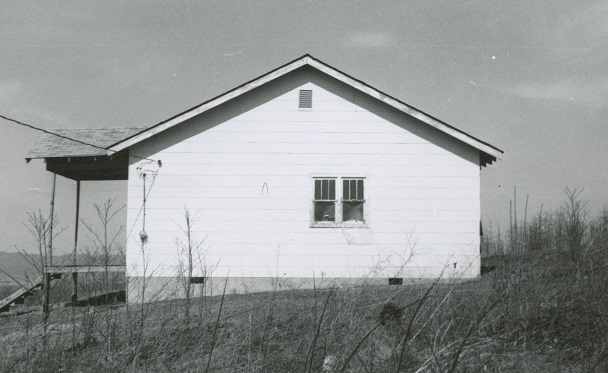
Construction began in 1951 on a small four room building. It included masonry walls, concrete floors, and an acoustic tile ceiling. There were four rooms a foyer and two restrooms with a wood stove. Construction was slow, taking about 6 years. It was dedicated in 1957.

Land behind the chapel was steep and heavily wooded making it impossible to photograph from that angle.

After the dedication, the branch expanded. Auxiliaries were organized, since they could take advantage of the constant access to the building. In a few years it became obvious that it would soon not be big enough. It would only be used for 20+ years before being replaced by the current building.

For a more complete history of the Slate Springs Branch and what became of it, see here...

http://amateurmormonhistorian.blogspot.com/2011/07/church-history-in-crossville-tenn-1878.html

Monday, July 3, 2017

Speedwell Chapel

Speedwell Tennessee entered Mormon history in 1908 with the baptism of Josiah & Harriet Haynes. Several of their children joined too, including a daughter, Pearly Shipley. She opened her home to missionaries when they came through, though at first it was only about once a year. The missionaries split their time between the Shipley family and the Haynes family. But it was widely understood that it was Pearly who was primary support for the Church in the area. Will and Cora Smith joined a short time later.

In 1936 the Speedwell saints were organized into a Sunday School, meeting in the Piney Grove Church on Jones Ridge. It was shared by different denominations and the Mormons used it early Sunday evening. Using a shared meetinghouse was not without its problems. At least once members arrived to find the building locked up specifically to prevent them from using it and guards to explain why.

In 1954 (one source says 1957) Mark Haynes donated land on which the church could build a meeting house. The Shipley and Smith families took out lines of credit to purchase building supplies, which was paid back through various member supported fund raising projects, included selling "sugar beets and green peppers" and other vegetables grown by volunteers.


It was a small wooden one room building located on the crest of Haynes Ridge. You could only get to it by following miles of dirt roads, which became impassable mud roads when it rained.

Carl Shipley, son of Pearl Shipley led the small group. He lived in valley to the north of Haynes ridge (the town of Speedwell is actually in the valley). Each Sunday morning, Brother Shipley drove up the mountain to Haynes Ridge. "Members along the way would see Brother Shipley and his mother, Pearly. They would follow them to the Church for Sunday School."


At first the Sunday School was dependent on the Knoxville Branch, and when that branch was split, they became dependent on the Knoxville South Branch. In 1970, the Sunday School was merged with the LaFollette Sunday School and some members from Tazwell and Middleboro. Of course this meant that Haynes ridge was no longer the best location in which to meet. So meetings there were discontinued in favor of joint meeting location at a house in Fincastle.

The Haynes Ridge building sat unused for a few years before being sold.  Eugene Muggridge describe the circumstances of the sale this way...

"During the Spring of 1974, Silas Mosingo had indicated to Grover Smith that he wanted to purchase the Speedwell Chapel and convert it into a home. He was moving from Michigan to Speedwell as soon as he could obtain a home. A price for the building and the one-acre lot was given by Brother Jim Judge, Church Real Estate Office. The Power of Attorney was delegated to me by the Church to finalize the transaction. Brother Judge sent me a warranty deed which had been prepared and signed by the Presiding Bishop, Victor L. Brown. The strange thing was that Mr. Mosingo insisted on meeting at Cove Lake State Park to make the final exchange of money for the deed. He absolutely refused to meet at the bank in LaFollette. He and I agreed to meet on July 4, 1974 at high noon at a designated place in the park. Not knowing the man, I was very apprehensive about the meeting place and about receiving a large sum of money."

"I lay awake worrying about the unusual arrangement. In preparation for the meeting and in an attempt to remove the fear that was beginning to gnaw inside me, I made arrangements for Roy Gene Smith, Grover Smith, and Leek Mayes to stay close to me during the exchange. These men were Elders, each weighed 250 pounds or greater and carried no fat. The Lord had blessed each with much physical strength, They could be tough if they had to be. Leek Mayes had just moved to Cumberland Gap from Cody, Wyoming where he had been running a ranch and wrestling cows for thirty years. Grover was 6 feet, 4 inches tall and could run like a deer. Roy Gene worked at repairing coal mine equipment and didn't know his own strength. I felt good hiding behind these good men."

"We met at a previously chosen place. Mr. Mosingo came alone and counted out the cash money on the tail-gate of Grover Smith's truck, while we four looked on. While the money lay there in full view, I gave him the warranty deed for the Speedwell building and Grover Smith occupied Mr. Mosingo in small talk, I picked up the money and stuffed it into a bag, then we transferred the bag to the bank. I was a little nervous to say the least, until that money was safe in the bank."

It may sound strange, and I'm not adding this to make a point, but the building burned to the ground "a few years later." Of course that means no current photos are possible.


Monday, June 26, 2017

Short Creek Chapel

Short Creek is a unassuming place along the east side of the Tennessee river in south west Perry County, Tennessee.


This undated photo looks like it was taken in the late 1930's or early 1940's.  That matches the other evidence I have for a branch at Short Creek. The chapel was built in 1928 and dedicated by Charles Callis. Attendance was small, often only consisting of only the Richardson family. In 1930 Jensen noted in his encyclopedia that there was a Sunday School at Short Creek, Tennessee. It wasn't a branch then and he specifically did not include it in his list of the three branches in the state that year. But Alvin Richardson serve as the President from 1928 until 1942. Exactly when it was considered a branch is vague. By 1940 references were using the word "branch" instead of Sunday School. In 1942 Marvin Dedrick was set apart as the new Branch President, a position in which he served until 1972.

I also have this dated photograph from 1944.


I looked at the names associated with the Short Creek branch I find a few who appear to be related to members from the earlier Spring Creek and Cedar Creek branches. This makes sense because those two historic branches were respectively south and north of Short Creek. But Short Creek included members from West of the Tennessee River and over much of Perry County. Another Sunday School met at Pope, Tennessee in Northwest Perry county.

In 1960, the branch moved into the old Lego Schoolhouse. It was only 1.5 miles away, so convenient for those who like the location of the old building. Unlike the previous building, this one had running water and indoor plumbing. Sadly, I don't have a photo good enough to share.

In the mid 1970's the branch had outgrown the Lego Schoolhouse and a new building was planned. A more central location was selected, in Linden, Tennessee. Members west of the Tennessee River were organized into their own unit putting Short Creek out of its central location. The efforts to fund the new building and justify the efforts led to the branch becoming a ward in the late 1970's. At the same time a new name was in order, so the Short Creek Branch became the Linden Ward. This new building is still in use today.


Monday, June 12, 2017

Nashville Chapel circa 1959

In 1959 the Nashville branch of the LDS Church met in this building. For those who know Nashville it is on the west end of town, halfway between Montgomery Bell Academy and Highway 440. It is a very nice part of town.


I've not been able to determine when the LDS Church bought the home or when they vacated it. Online records just don't go back far enough. It is a private residence now. The home sold for $700,000 in 2012. You can see some great photos of the inside here. The new owners built an addition on the back. In May 2015 the home received an honorable mention for residential historical preservation from the Metropolitan Historical Commission of Nashville.


Monday, June 5, 2017

A Place for the Un-Gathered: The Home of Abraham and Mary Church of Hickman County Tennessee

[Below is an abridged version of my presentation at the 2017 Mormon History Association conference in St. Louis, Missouri last week. - BAllen]

In 1982 Historian Jill Garrett took several photographs of “the old Mormon place” along the banks of the Duck River in Tennessee. It was part of an historic community called Shady Grove.  The photographs which Mrs. Garrett took would be the last taken of the home of Abraham and Mary Church which was the center of the LDS missionary efforts in middle Tennessee for many years.


In 1833, Abraham and Mary Church purchased 543 acres of land along the Duck River in middle Tennessee. On that site they built, or perhaps expanded, their new home.
The design itself consisted of two almost separate structures with an open space between them called a dogtrot, which helped circulate the humid air.  It was all covered by a shared roof which also provided a sheltered outdoor living area.  Unlike other similar style homes, the dogtrot had a wooden floor and a second story running the length of the structure with rooms even above the dogtrot. The single roof created small but useful attic spaces above and on the rear side of the second story.  Further outdoor living space was provided by a front porch running nearly the length of the home.
There were other structures on the property too. There was a barn, a smoke house, stables, other unspecified out buildings and a cemetery. There were also slave quarters though no one bothered to mention them let alone describe them.

Mormon history in Tennessee began in 1834 when David Patten and Warren Parrish preached along the lower Tennessee River.  In June 1836, while escaping from a mob, the two reached safety in Hickman County. They proselytized there from late June to August in 1836 during which they met the Church family. Unfortunately neither missionary wrote about it.
The Churches, however, happily told others about their brush with fame. The earliest written record comes from Parley P Pratt Jr., a missionary who preached in Shady Grove in 1878-79. Pratt wrote “The Gospel trumpet was first sounded in this place over 45 years ago by David Patten and Warren Parish and the people in the immediate vicinity for many years past have had many strong testimonies of the truth of the great Latter-day work.”  As you might imagine this tale gained more details as the years passed. For example, latter versions recall Patten not for his preaching, but for his having gone hunting with the boys.
Despite this early contact, none of the Church family were baptized in 1836.  In fact, Shady Grove does not actually appear in LDS records for another five years.

In 1840 or 1841, two unnamed missionaries  arrived at the Church family home. They started their visit with a hymn. The oldest son, twenty-three year old Haden Church, said that just from the song they sang, he knew they were telling the truth.  He dropped everything and went to Nauvoo to meet the prophet. There, Haden was baptized in the Mississippi river by Joseph Smith on April 5th, 1841.
Two years later Haden returned to Shady Grove, this time as a missionary, setting up shop in his childhood home. His companion John Brown wrote “We arrived at Brother Church’s father’s home. He and the family spared no pains to make us comfortable though none of them belonged to the church at that time. Here we stayed and rested a few days.”
Despite the hospitality, they accomplished little in Shady Grove. They expanded into nearby areas but eventually headed south where they would have more success in Alabama and Mississippi. While they were still in Tennessee Haden returned to Shady Grove frequently, often without his companion. After almost a year in Alabama, Haden again returned to his parents’ Shady Grove home.
In July 1844, Haden Church was joined by Abraham O Smoot. A few days after his arrival Smoot heard rumors of the death of Joseph Smith, followed a few days later by confirmation letters. Smoot and Haden left Shady Grove together and returned to Nauvoo.
According to folklore Abraham and up to three of his sons, Emmons, Robert, and Charles also made their way to Nauvoo where one or more of them were baptized. That’s another story that gets more details as it is retold.
Haden did not stay in Nauvoo very long. He returned to Tennessee later the same year perhaps with the hope of converting those who had not yet joined the Church, but certainly with the intent of marrying a convert from Mississippi, Sarah Arterbury. After the wedding on December 17th 1844 they moved to Nauvoo the next year, before heading west to Utah.

It was about then that the first Abraham’s other children joined the Church.
His daughter, Christine Hoover, was baptized probably in 1844 by a companion of Haden’s named Benjamin Clapp. Late that year Christine and her husband had a son whom they named Joseph Smith Hoover. However, Christine and her husband - he was never baptized – chose not to gather with the saints as Haden and Sarah did.
Emmons, one of the three sons who were perhaps baptized at Nauvoo, showed no interest in gathering.
 Robert, another rumored Nauvoo convert, had no interest either.
 A third son, Thomas was baptized sometime in March 1847, a date recognized in church records. Thomas also stayed in Tennessee until well after the Civil War.  It was their father’s home around which they gathered to worship, though perhaps only when Haden returned on his frequent visits.

There is no evidence outside folklore that Abraham Church was ever baptized Mormon. He did subscribe to the Times and Seasons in 1841. But that in and of itself does not indicate church membership. In 1851 Abraham died, passing the family home on to his son Robert.
I have not been able to locate a will or another document showing how much land or property Abraham passed on to his children. I know that Robert inherited the house and some of the land on which it stood. From the 1850 census we know that Abraham valued his real property at $6,000 and that he owned 21 slaves.
In the years just before the Civil War, contact with the LDS Church in Utah slowed considerably. Haden returned once more splitting his time between his own and his wife’s families. Though some were members of the LDS Church, none of them returned with Haden to Utah.

Immediately after the war a few missionaries went back to the US South. One of the first places they went to was Shady Grove. Haden was there off and on between 1868 and 1870, and again in 1875. As before the visits were centered on the Church family home.  Robert, now called Uncle Robbins, was the head of the house. He and his wife were as gracious hosts as his parents were before them. The rest of the family embraced the LDS Church as well.  Haden’s brother, Charles and his wife Dolly found the time and resources to travel to Utah in 1872 for the sole purpose of receiving their temple work. Haden Church’s remaining siblings were baptized in or before 1875.

Haden was frequently sick while on his missions. His final one in 1875 was no exception. He spent the last few months of his life suffering from what was probably typhoid fever. After Haden’s death, his companion Henry Boyle explained in a letter to Brigham Young “[t]here are five brothers and three sisters of the deceased all living near here, all members of the Church, and who did all in their power to bestow upon him all the care and attention that his case required”   The family buried Haden in the cemetery beside the home near the grave of his parents.

After the death of Haden Church, his family continued to offer sustenance to the visiting missionaries. Many used it as a base, striking out to nearby venues to preach. Other branches opened up within few miles. In addition to Shady Grove, there were organized LDS congregations meeting at Totty’s Bend and Love’s Branch, with smaller informal groups nearby. More branches were organized all over middle Tennessee. In 1881 the Tennessee conference split in two: East and West Tennessee, with Church family home in Shady Grove as headquarters of the west conference. Two years later there were 14 active, well-attended branches in the West Tennessee Conference. It prompted another split, creating the Northwest and Southwest Tennessee conferences.
Members of the Shady Grove branch were faithful saints, but found alternatives to gathering. Emmons Church found the time and resources to go to Utah in 1877 to receive his temple work before returning to Tennessee.
Charles Church and his second wife Sarah gathered to Colorado where their fourth child was born in 1881. Under the direction of John Morgan, Colorado had become a secondary gathering point for the Saints from the Southern States Mission. By 1884, however, Charles and family had returned to Tennessee.  Key to their being able to return was the existence of a home and family at Shady Grove to which they could “ungather”.

The Church family home was considered such a safe place, that missionaries who needed some convalescing time would travel to there simply to recover. One example is J. Golden Kimball. Suffering perhaps from malaria, Kimball left Chattanooga where he was working with B H Roberts, and took a train north to Nashville then another south to Columbia; a trip of over 180 miles. There he would have had to hire a wagon or walk, for the last fifteen miles.
Kimball did not, however, get the chance to recover for long.  On Aug 10th 1884, a mob killed two missionaries in nearby Cane Creek. Two other missionaries escaped the mob, though they were separated from each other. Each determined to head for the safety of the Church family home at Shady Grove. Meanwhile Elder Kimball heard rumors of the shooting and tried to investigate, once on the 11th and again on the 12th. Each time he met one of the escaping missionaries along the way and they headed back to Shady Grove, and relative safety.
But the shooting death of Elders Gibbs and Berry would forever alter the role the home at Shady Grove could play. Upon hearing of the violence, Robert Church became severely ill. Descriptions of his condition are vague, describing initially fits of anxiety and incoherent ranting followed by a feverish calm.

Later that week B H Roberts arrived at Shady Grove, intent on retrieving the bodies of the two slain missionaries. At the Church home he secreted himself in the smoke house to create a disguise. You can see him in his disguise in this relatively famous photo.
He shaved his beard, exchanged his clothes for ones provided by various members of the Church family, including boots from one of the family servants. Using soot from the walls of the smoke house, he covered his pale skin. Roberts was able to successfully retrieve the bodies putting them on a train for Utah.

After lingering for 10 days, Robert Church passed away. B H Roberts reported on the funeral to the Deseret News and so was likely there. Other missionaries were present and preached the funeral sermon. Robert was buried in the family cemetery next to his home.
After the funeral the missionaries were fearful for their safety, even at the Church family home. The following morning, the entire contingent of the Northwest Tennessee Conference left for Nashville . Some went home, others were assigned to other areas in Tennessee.
Robert and his wife Laura had no children.  His verbal will left nearly everything to his brothers, George and Emmons, who were to make sure that his widow Laura was well taken care of.  Laura’s share was 105 acres which represented one third of Robert’s real estate.  The other two thirds went to George and Emmons. For reason we can only speculate, Laura sold the house two years later.
With the removal of the missionaries, and the sale of their meeting place, the local branch struggled. Some members of the branch moved west to places as varied as Utah, Idaho, Colorado, and Texas. Many remained but few of their children stayed in the Church.

Joseph Bond purchased the home in 1887 and lived there for twelve years until his death in 1899. It then passed to his daughter Ida Shelby who lived there until the 1950’s.

The home, and the land under it, was purchased by a chemical company for the mineral rights on the accompanying land.
In 1983 Sarah Cannon purchased just the home with the intent of moving it.  Mrs. Cannon was well known at the time for her comedic persona Minnie Pearl. Her act included many self-deprecating jokes about the town in which she grew up; the fictitious Grinders Switch.
There were, however, plans to make the town real.  The hope was to create a tourist attraction; a place where devoted fans of Minnie Pearl could visit and experience a little bit of the southern culture of which the actress gently poked fun. To this end the Church family home was purchased and dismantled carefully. Each piece was labeled and moved to the site of the future park.
The home was not the only building in the project. This one was moved intact.
In 1991, however, Sarah Cannon suffered a stroke. The project was placed on hold. The pieces of the old home, logs, windows, doors, and foundation stones, were left exposed to the elements. Months turned into years and in 1996 Mrs. Cannon passed away. The project and the home that was meant to be a part of it were forgotten. Today the only reminder of the homestead is the cemetery.

As it became obvious that the home would not be rebuilt, descendants of Abraham Church sometimes visited the disassembled home at Grinders Switch. More than one took a memento home with them. These were collected by a great great granddaughter of Abraham Church from debris of the home while it was at Grinders Switch.
Hickman County later purchased the land at Grinders Switch for a new Agricultural Center and hired someone to clear away the debris. The contractor dumped what he hauled away on his farm.
The fascination with the home, however, continues. In 2014 one descendant collected a few stones from that farm and passed them around to his cousins; including one stone which was mailed to Texas.

Monday, February 1, 2016

Hampshire Meetinghouse

I have posted a photo of this meeting house before with a groups of people in front of it here. A few weeks back I found more photos, including this one in color. The notes say only that the meeting house was built in 1937, which matches the information I have.


The building is no longer standing. I have been told that after the Church moved on to a larger building in Columbia, the land owner had it torn down and built a home on the spot. 

Monday, December 1, 2014

My Visit to the Modern Lebanon Ward

Last week I stepped outside my comfort zone. I am an introvert. In general I avoid crowds of people I don't know. I'm not, however, shy. It's not the same thing. Meeting and talking with strangers is a chore, one that I can do but which comes at a cost. For me it is exhausting. I can get up on stage or stand at a podium and, well, put myself out there, but I have to have a reason. Being a historian, even an amateur one, gives me that.

So last week I harnessed that reason and took myself on a trip 75 miles away. My stake was having Stake Conference and my ordinary responsibilities at church were not required. For a few months I have been working on a history of the Baird's Mill Branch in Wilson County Tennessee, and I thought "why not go visit the modern local ward in the Wilson county seat of Lebanon?"


Yes, I know. It was a gloomy day; overcast and drizzling rain, and I was running late. Lebanon is further away than I remembered. I arrived during the rest hymn, and sat in the foyer. I didn't ask but I would have guessed there were a little over 100 people in attendance. As the service ended I got up and walked into the chapel and found a seat. I correctly surmised that Gospel Doctrine Class (the Sunday School class for adult members) would be in the chapel next. As I watched people visit, talk and socialize (all extrovert activities) I was approached a few times and asked to introduce myself. Good thing too. There was no way I was going to approach anyone myself. 

"Yes, I'm a member" "No, I'm not moving into the area" "My great great grandfather served in Wilson County from 1883-1885." "His name was Jacob F Miller", "No, he was not one of B. H. Roberts' companions" Usually by then people lose interest in history and the conversation goes on to other things. 

One person persisted. He was the first president when the branch was formed in 2002. It is now a Ward, with a new building that is just 5 years old. I was also able to get the name of one person (who attends another ward) whose family were members in Lebanon years ago. Maybe that will turn into something. It wasn't long before my introverted self had had enough. The members of the Lebanon treated me well. "Its not you. Its me."as the saying goes. 

As I pulled out of the parking lot I decided to drive by Baird's Mill and take a quick photo. Little exists of the original community. No post office, no furniture factory and no saw mill. The lake which was fed by ground water and helped grow Baird's Mill over 100 years ago is long gone. I'm not sure I could conclusively pinpoint where it was, but I have some theories.  Names, however, are oddly persistent. This modern sign marks a housing development less than half a mile from the original. After taking the photo, I turn my car around and head home.


See my other Wilson County posts on.....


Monday, August 18, 2014

Linden Ward Open House


On August 10th, 2014 the Linden Ward of the Franklin Stake held an open house. You can almost feel the intent behind the event. On the 130th anniversary of the Cane Creek Massacre, members of the congregation which included the site of the massacre wanted to open their church to their neighbors.

The event was to be 3 hours long, and included stations throughout the building that showed off specific aspects. This ward has four missionaries. Sister Curtis and Sister Ferrin and Elder Goal and Elder Steve. In an inverse relation to my age, missionaries are getting younger. And these seemed more youthful than the current age limit would appear to allow. They spoke about their testimony of the newest paintings in the foyer.

After seeing the foyer, we moved on to the Chapel where members of the Ward discussed what happens during a typical LDS service. There was time for questions, and several people took advantage of that. We moved on to the Young Men's room, which was positioned behind the not-so-sound-proof dividers at the rear of the chapel. In any other building this would be the overflow before the cultural hall (Translation: indoor carpeted basketball court). But this building does not have one ... yet.

Our tour led us back across the foyer to the Clerk's office and the Bishop's office. A member of the Bishopric was there to describe what the Bishop does and answer more questions. My tour was interrupted as more "real visitors" (translation: non members) arrived. I missed out on seeing the Young Women's room, the nursery and the Primary room. I did see the media center, and the kitchen, which were unstaffed.

For those of you imagining your own building as we walked through these rooms, I have to stop here and say you are thinking too big. I could have stood in a single spot and seen the door to everything on my tour. The stations were only feet away from each other, so I could see and hear many conversions going on all at once. Despite this, great effort was made to create an environment conducive to  feeling the spirit, and they were successful on several counts.

Refreshments were available at the end. More sugar than is healthy for the average person, let alone a diabetic. Plus reading materials on church programs for food storage, family history, and more. One enterprising Ward member created DVDs with the combined video clips from the scriptures that the Church has put online. These were given out as gifts to the visitors.

I was there for 45 minutes, much longer than the 15 minutes the local thought each tour would take, and I did not get to see everything or talk to every one. Before I arrived about a dozen people had been through already. And another two dozen or so arrive while I was there. I left by 3:00 with another two hours to go. To put that into perspective, this ward covers all or part of four counties: Perry, Decatur, [most of] Lewis, and [northern] Wayne. The meeting house sits in a rural location 7 miles outside of the town of Linden which has a population of just over 900.


Monday, November 26, 2012

An Old Chapel in need of Repair

At our Ward Conference not too long ago, I was approached by a friend from the other side of the McMinnville Tennessee Stake whose family has been in the Church in Tennessee for several generations. During our conversation, we discussed an old Church building that has fallen into disrepair. The grounds are overgrown, there are leaks in the roof, the ceiling is sagging in some places. The ornate original doors were removed for restoration and have since disappeared, while the temporary doors are functional, they are not much to look at. The building is being used as a storage unit, with old Christmas decorations, even half used paint cans, and many more things just stacked up on the pews.


The Church does not own this building. It belongs to a cousin of my friend. But the church built this building between the two world wars, with local member work, and some financial assistance from the Church. It was, and still is, a beautiful building. It isn't even the only old chapel in the Ward. There is an even older one that was dedicated in 1909. That building has made it on to the National Register of Historic Buildings. Members from the ward and the stake donate their time and resources to keep it looking nice. But the middle building, like a middle child, is neglected. Perhaps two historic chapels in the same ward is too much.The new building being used today was built in the 1980s and is wonderful. But it doesn't have the character of the older one.

The church does not have a track record of saving every old building. But Tennessee has very few old chapels. A even fewer with this much character.

Monday, November 19, 2012

McMinnville TN Stake Assembly Hall

Most of the time when I look for a piece of the Mormon experience in Tennessee, I find it in a library, archives, or some other repository. That is, if I find it at all. More often than not, I find nothing, or perhaps I find something else that interests me.

Sometimes, I just trip over something completely by accident, when I'm not even looking. I wish I could make events like that happen, but there is no way to control it. Today (as I write this) I was at a wedding reception. A young man I knew from a previous ward was getting married to a recent convert. I knew many people at the reception, but I knew no one from the brides family.

After getting some food, I sat next to my wife at a table where a mixture of guests were already seated. One couple at the table were relatives of the bride. Neither were members. The conversation spanned many subjects. Careers, living in Tennessee, and the good match the bride and groom would make.

At one point we discussed the other Mormons they knew. The husband, David, was in commercial construction. He asked where the local Stake Center was. It was an odd question from someone who was not a member. But it turned out David was very familiar with what a Stake Center was. David was the project superintendent on the building of the McMinnville Stake Center, which until 3 weeks ago, was my stake center.

David had many comments about the Stake Center. Locally we call it the Assembly Hall, since none of the wards actually meet there. It is used just for stake offices, and has a large assembly room for Stake Conferences, dances and other large events.

As an outsider who worked with Mormons, David had some interesting observations. I won't share all of them in today's post, but I did want to share his revelations about the building, from builder's point of view.

One odd feature of the Stake center is the footing. According to David the footing is 3 feet wide and 6 feet deep. I'm no engineer, but David explained that such a deep and wide footing was overkill, to the point of being too heavy for the surrounding ground. It was required by his contact at the Church, and there were no changes allowed. At one point construction stopped for three weeks because the plans called for the wrong kind of screws to secure sheets of drywall to the ceiling. The plan called for a screw designed to work with metal studs, when the studs in this case were wood. It took three weeks to get approval to modify the plan to allow for the correct kind of screw.

Overall David said the experience of building a Stake Center was a positive one, though he wasn't sure he would do it again. Although the building requirements were rigid, there was a way to make changes, even if it was slow.

Monday, April 23, 2012

The First Chapel of the Shelbyville Tennessee Branch

When the Shelbyville Branch was formed in the early 80's, from a portion of the Tullahoma Ward, the members met in the old Carney building in down town Shelbyville. The building, which once held the infirmary, was beautiful but it needed some work. The members donated time, work, and money to bring it up to par for use as a chapel. I, for one, would have loved to meet in this building. I'm sure the upkeep was expensive, as older building generally are. Plus retrofitting an older building with air conditioning and for accessibility while maintaining the historic appearance can be a challenge. The chapel was only used for three or four years before the new building was built in 1986. As of 2012, the old building is still standing.

Monday, July 25, 2011

Church History in Crossville, Tenn 1878-1957


Crossville is a city in east central Tennessee which today has about 11,000 people. It sits at what was the crossroads for Nashville-Knoxville traffic and Chattanooga-Kentucky traffic. Its "on-the-beaten-path" location meant it was hard hit by the depredations of the Civil War from both sides. Elder Parley Pratt Jr. and his companion Daniel Stuart undoubtedly passed through in 1878 on their mission to east Tennessee, since there would be no other way to go. Though he does not note it in his letters, one Crossville newspaper reported that in the nearby town of Newton [seven miles southwest of Crossville] in November 1878 that...

We had quite a confusion at church Sunday on account of the appearance of two Mormon brethren – “Normans” as they are styled in this community. Brother Simmons, Baptist preacher in this place spoke against their beliefs and when he was through one of the Mormons asked permission to speak and he came down on the Baptist denomination. Brother Simmons came very close to giving him the “ghost” but not so very holy either.

The earliest baptisms in the Crossville area are in 1906. On April 15th of that year Sallie Durham Barnes, a 43 year old woman joined the Church without her husband. They lived in Linary, about 6 miles south east of Crossville. Also baptized on the same day was 15 year old Johnny W. Carpenter. His mother, Mary E. Carpenter, was already a member, says one source, but without an explanation of where or when she was baptized.

The record from there on is equally sketchy. On August 6th 1911 Malisa "May" Hyder was the first to get baptized in her family. How she met the missionaries, even who she met, has been lost to history. The Hyder family lived in Slate Springs about 8 miles north of Crossville.

On September 15th 1912, Sallie Durham Barnes, had her son Charles Henry Barnes taught and baptized.

In January of 1913, two missionaries Elders Earl B. Hales and Orson Sprague held meetings in nearby Dorton, about 4 miles east of Crossville. They were well received, although they had no baptisms before obligations elsewhere required them to leave.

In the next few years adult children from both the Barnes and Hyder families were taught the gospel and were baptized; Ulysses Grant Barnes on 18 June 1914, Carrie Hyder (Warf) on 9 Aug 1914, Maude Hyder (Jolly) on 9 Aug 1914, and Nora Hyder (Warf) on 7 Nov 1915.

In 1918, Elders Lionel LeCheminant and Charles A. Robbins had a "protracted appointment" at Crossville. It was at this meeting that Ivan Leland Barnes was baptized on Oct 9th 1918. A year later, Elders Langston and Davis were in Crossville receiving even greater attention, and more baptisms. Catherine Hyder (Hamby) joined the Church about this time, though the exact date is unknown.

From 1922 to 1924, Elder Rulon Killian and his several companions visited the Crossville area and baptized several families. There were relatives of existing members, like the Hamby's, Barnes', Hyder's, and Goss' as well as new families like Jesse and Amanda Adams.

In 1926, "The East Tennessee conference was held in this place Saturday and Sunday, July 24 and 25, and the court officials generously granted us the use of the Courthouse in which to meet. The courtroom is large, cool and well seated. At all the public sessions of the conference there were fair-sized congregations but on Sunday night, when Prest. Callis gave an illustrated lecture, the large auditorium was filled. Fully seventy per cent of those who attended the conference were non-members. Prest. Douglas and his associates are entitled to much credit for the excellent arrangements made which contributed largely to the success of the gathering." (Liahona: The Elders Journal)

Sister Mayme Goss (Pugmire) remembered that meeting. It was the one and only time she walked to Crossville. When it was over the missionaries stood at the doors thanking the people for coming and passed out tracts. Some people took several, others took them and threw them on the ground once they were outside. The missionaries just gathered up the discarded tracts saying "That was too bad they did that, for one day they'll want to know what was in those tracts."

Conference organizers even arranged a baseball game between the Elders and the local Crossville team on the Saturday between sessions. The game, no doubt, drew out some who would not have come otherwise. The missionaries lost three to four.

In general the people of Crossville were accepting and tolerant of the Mormons. Although the elders were once invited to an outlying community where they were pelted with eggs and tomatoes, the honest and accepting folks of Crossville did not tolerate violence. In addition to being allowed to use the courthouse, the missionaries were even invited to speak in the chapel of the Union Methodist High School in 1928 through the efforts of Gladys Hamby, a member of the church and a student at the school. Another conference was held in the First Congregational Church with the permission of the Reverend Abram Nightingale.

In 1930, a Sunday School was organized with Ivan Barnes as the superintendent. Harold Goss, and Richard Hamby assisted him along with Mable Hyder, Stella Hamby and Ruth Hamby.

Wayne J Stephens and his wife Ida "Ethel" Stinson Stephens came to Crossville from Glenobey, Tennessee. to assist in building up the church. Wayne had joined the church in 1911 and had already been ordained an Elder. His business was in motor freight. When conferences of the Church were held in other areas of east Tennessee, he would take one of his trucks and install seats in the back. There was room in the truck for whomever wanted to attend the conference from Crossville. The novelty of the Crossville saints arriving by truck was described more than once in mission reports. But they did more that provide rides. The built leadership too. Willima Harold Goss was probably the first person from th area to receive the Melchizedek Priesthood. He was ordained an Elder in 1938. It was through Wayne and Ethel's hard work that a branch of the Church was finally organized in 1939 at Slate Springs, eight miles north of Crossville.

A Relief Society was organized in 1943, with Stella Hamby as President, Amanda Adams as First Counselor, Frances Goss as Second Counselor and Minnie Goss as Secretary. In 1946, two sister missionaries Rowena Russell and Meta Johnson organized a Primary. They also began collecting pledges for work on a new chapel. The branch had been using the community school house, but after the school moved into a new building, it began to fall into disrepair.

Land was purchased and construction began in 1951. The building was a simple four room structure made of masonry walls and a cement slab floor. It was dedicated in 1957.

[postscript: The Slate Springs Branch was renamed the Crossville Branch in 1972, and in 1976 a new chapel was built closer into town. In 1991 the Crossville Branch became a Ward.]
Crossville chapel today

Friday, October 8, 2010

Northcutts Cove 1909

It never fails. Just as I finish a post, someone sees it and says "I have something you want." And so it is with this photo. Dated 1909, this photo of the Northcutts Cove Chapel at Larsen Tennessee, (just north of Altamont, Tennessee) may have been taken at the dedication which was in October of 1909. Part of me thinks I can see Charles A. Callis in the photo. He spoke at the dedication and at the public debate immediately following it. But the images are just too small to tell.

Wednesday, October 6, 2010

Chapels in the History of Altamont Tennessee

On my way home from a long work assignment, I realized I would be driving "close" to Altamont, Tennessee. Altamont is the county seat of Grundy County and sits on top of the Cumberland Plateau. Grundy county also has the largest concentration of LDS members in the state of Tennessee.

I say I was on my way home, but Altamont isn't on the way to anywhere. Like Cane Creek, it is an hour from the nearest interstate. I left I-24 and followed Hwy 50 East. I passed through some small towns before the road begins the climb. Almost immediately it turns back on itself again and again in a series of switch backs. All told the elevation climbed 800+ feet in just 3 miles. Seven miles further was the town of Altamont; population 1,300.

It is here that the oldest LDS chapel in Tennessee is found. Dedicated in 1909, The Northcutts Cove Chapel certainly wasn't the first, but it has survived where the other have not. I kind of knew where the Chapel was, so I figured I wouldn't get lost. But there is another chapel I wanted to see, built in 1947 to replace the first. It is beautiful, built from colorful stone. It isn't being used anymore, so GPS would be of no use here. But I knew it was somewhere near the courthouse. As I turn from Hwy 50 left onto Hwy 56 I mentally look around for the court house. I hadn't driven a 1/8th of mile when I saw the stone chapel. It is closer to the road than I had imagined, but nothing is quite how you imagine it. The Church doesn't own it anymore. The last I heard the city was using it to store records.

I drove north on Hwy 56 and completely missed my turn, and had to drive quite a ways before I could turn around. The road I wanted was appropriately named Northcutts Cove Road. The Northcutts family figured prominently in local Church history. The Cove, known as Larsen when the chapel was first built, was the birthplace of the church in the area. A friend sent me a photo of the Chapel from 1913. The first thing I thought when I saw it was "I wonder if I could get a photo from the same vantage point."

What followed was some geometry based on the apparent angle at which the Chapel is seen in the old photo (14 degrees) off perpendicular. My math was rustier that I thought and I had to look up the formulas. Add in a Google Earth photo of the chapel to determine where the vantage point was. The best I could do was a line drawn across the map. Somewhere along that line the photographer stood. Further guessing that there was an elevation difference of about a hundred feet, I could pretty easily pinpoint on the map my destination.

Driving along Northcutts Cove Road, I notice road signs that let me know I am getting close to the right spot. I passed Ray Fults Drive and W. Smartt Road, both family names linked with the building of the Chapel in 1909. It was W. Smartt Road I was hoping to take to my destination. But the rusty iron gate padlocked across the chert gravel road, made me change my mind.

I drove on, down the hill to the cove far below. Almost immediately the small white chapel came into view. There were few things different from the photos I had already seen. Tall bushes hiding the front of the building had been cut down. And a new stone marker had been added to the grounds commemorating the 100th anniversary of its dedication.

Recently placed wreaths in the cemetery behind the church, remind me that people connected to the church still live nearby. A piece of me secretly hoped someone obviously connected to the chapel would see me drive up and come to introduce themselves. The land has since passed into private hands, but they are members of the church, I am told, and are proud of their connection to their piece of history. None of the homes in the distance are obviously connected to this property, and I'm not enough of an extrovert to just walk up to the homes of people I don't know. Yes, tracting was horrible.

I turn to the south and look up at the point I was hoping to get to, but couldn't. Part of me is consoled by the fact that today, the hillside is covered with trees. It is unlikely I would be able to get a clear shot roughly approximating the original.

As I get in my car to continue my trip home (two hours later than I was expected), I think of the narrow window of opportunity this community sat in during the turn of the last century. Had the missionary success happened a few years earlier, many of the converts would have emigrated to the west, leaving little lasting imprint of their proselyting efforts on the local community. A little later, and there would not have been enough time for the local church to grow as it has here.

[As I am nearly home I realize I didn't stop at the newest chapel, the one the saints in Altamont use today. The third would have rounded out the visit. Perhaps even have been a interesting way to mark the growth of the church. Architecture as a proxy for history. Mmmmmmm.]

Monday, October 4, 2010

Larson, Tennessee

Situated in the hills of southern Tennessee is a small one room church house. In 1913, when this photo was taken, the closest post office was at Larson, Tennessee. At the time the chapel was just four years old. and was the start of a very successfull branch of the LDS Church. By the time the photo was published the post office closed down. Eventually the area came to be called Northcutt's Cove after the LDS family that lived there. Accompanying the photo was the following description.

Elder Marion P Hutchings, President of the East Tennessee Conference, reports that the work of the Lord has never looked more encouraging than in that place at present. "The counties and towns in the past who have bitterly opposed us to us are now receiving the elders. The churches and school houses are being opened up for our use all through the conference and the people seem to be much more anxious to hear the glorious truths of 'Mormonism.' On July 24th, six of the elders met with the saints and friends at Larsen, where we have a beautiful little church and about fifty members. This was the first entertainment of the kind ever held in this section of the country. The elders laboring here are:  James L Marler, Lewiston, Idaho; George A. Sampson, Delta, Utah; Charles R Bennett, Holbrook, Idaho; Conference President Marion P. Hutchings, Beaver, Utah; Orson M. Sprague, Mesquite Nevada; Earl B Hales, Riverside, Utah."


Friday, July 9, 2010

The Mormon Chapel that never was


In Duff, Tennessee, less than a mile from the site of the historic marker for the actual Mormon chapel, there is a beautiful chapel built with the donation of Mormon money that was never used by Mormons.


George Washington Riggs and other early members of the Church in Duff, Tennessee, joined with other community leaders to build a church which would be shared by all of the denominations. Brother Riggs personally donated $5,000, which was no mean sum in that day. And he was not the only Mormon benefactor.


We did not get to go inside the day we visited. But most of the interior is "sanctuary" itself, two stories high, with small classrooms built in each of the four corners. There are two classrooms in each corner, one above the other, making in total eight small rooms plus the sanctuary. The basement is used now only for mechanical space.
  

I love the detail of the brick used. Special attention was used to make the brick colorful. Closer inspection showed the color is not paint. The pigment is clearly part of the brick, though whether it was baked in or added as a stain afterwards is beyond my expertise to determine. The color does not bleed into the surrounding mortar, which leads me to believe it was not applied after construction.

But ultimately the project ran out of money. A corporate benefactor eventually stepped in and completed the chapel. A board of directors was established and they started to work out a schedule for sharing the building. But in the process, the Mormons were left out. Efforts to resolve to issue were fruitless. And in a moment of frustration feet were dusted and a curse placed on chapel.

From then on, nearly every attempt to use the chapel by the other denominations ended in bitter arguments and acrimony. The spirit of contention took over the place. Fights that broke out at the meetinghouse became infamous and are remembered even today. The Mormons have never used the meetinghouse for services. Eventually the building was sold and it is now used by a single denomination.

The missionary who dusted his feet made annual trips back to Duff for many years after that. Recently he took pity on the denomination currently using the church. He made a special trip to lift the curse.

Saturday, July 3, 2010

Duff Chapel Marker

In early June, I took a business trip to Knoxville, Tennessee. While I was there I met with Jim, whom I had met at the Mormon History Association conference. Through Jim, I met his wife and his mother-in-law. The four of us took a trip into the mountains north of Knoxville to where a small community of Mormons lived since the 19th century. Eventually they built a chapel. There we located the marker you see below. It reads:
A Sunday School was organized in 1943 by Elder George Quist, A full time missionary. During 1948 a building was erected at this site on land donated by Charlie Wright. Money was raised by the Riggs and Wright families. Members, friends and full time missionaries. The small building served members until 1956.

Like many early pockets of the LDS church in the southern states, this branch began with the conversion of a family in an isolated rural community.

In 1948, land was provided for a small chapel. Service missionaries were called, money was raised and labor donated for the completion of the one room chapel. By the time I visited, however, only parts of the foundation are left barely visible under the grass. Based on what I saw and heard from those who were there, the chapel was probably about 20 feet wide and 30 feet long. At one end, the floor was built up a little higher to serve as a stand. A single wood stove provided heat for the entire building. Sacrament services were held in the chapel and Sunday School classes would split up, some using rooms in the home next door.
The home and the land belonged to Mary Wright, but since there was another Mary in the congregation, everyone called her Aunt Mead. The house no longer stands, but behind where the house was is an old water pump which is still there. No, it doesn’t work. We tried.

The marker was placed about 10 years ago. My hosts, descendents of the Riggs and Wright families, are pretty sure the structure was still being used in 1958, not 1956 as the marker says. Regardless, the marker is an important reminder of the sacrifices and dedication of the members of the Church in Duff, Tennessee. From these early pioneers, a faithful body of saints has grown into the strong membership of the church it is today.

[Thank you to Jim and his family for pointing out this wonderful piece of history. -Bruce]

Sunday, May 23, 2010

Hampshire Branch


I love this photo. I know it is hard to read, but the inscription above the doorway reads "The Church Of Jesus Christ of Latter-day Saints" I have not firmly identified the location of this church yet, or if it even still exists.

Frank Wirig, a missionary who severed in Hohenwald, Tennessee, took this photo in 1948. He identified two people in the photo: Branch President Eldridge Lee Travis in the front-center and Elder Deon Hubbard in the very back. I believe this chapel was in Hampshire, Tennessee, a small town 18 miles east of Hohenwald. A branch was meeting there in 1949 according to newspaper reports at the time. And interviews I've had with local members now living in Nashville indicate there was a chapel built there near a creek. Hampshire is in Maury county. Hohenwald is in Lewis County, just four miles south of Cane Creek.

Below is Elder Wirg's description of the photo.
If you have any information about this chapel or the people in the photo. I would be very interested to hear from you.
Brother Travis was Branch President of the Branch. There was a cement block chapel. The creek that went past the chapel had flooded and left about four inches of mud and sand on the floor of the church which had to be shoveled out and cleaned. And in the picture in front of the church, Elder Deon Hubbard (with the wavy hair) is standing on the top of the stairs in the back. President Travis is standing in front.

Friday, October 30, 2009

Old Altamont Mormon Church


Below is an article written by Gordon B Hinkley about this beautiful chapel in Altamont, Tennessee.


 "Salt of the Earth…." January 3, 1948
Persistence Wins For Southern Leader
By Gordon B. Hinckley


All men dream. Some men work to make their dreams come true. The labors of Lewis F. Fults over the past 25 years have brought the fulfillment of a dream that has proved a blessing to the Church and to the community in whichhe lives.

Altamont, Tennessee is a town of only 300 people. Almost half of theseare members of the Church. Twenty-six years ago when Elder Fults and his wife moved to the community, they were the sole members. The only knowledge the people of the area had of the Mormons came from the occasional passing visits of two missionaries moving through the county, each carrying a heavy suitcase and an umbrella. Brother Fults dreamed of the day when there would be a congregation and a chapel in which to meet. And then he set to work to makehis dream a reality.

He became postmaster, and operated a general store and filling station. He forced his opinions on no one, but those who traded with him, received more than letters and groceries and gasoline. They learned something of the Gospel of Jesus Christ.

He ran for the office of county registrar, and was elected and is now serving his fourth term, each of four years. For the past ten years he has also been mayor of Altamont for which he receives no pay beyond the gratitude of his fellow citizens.

As many people of the community and the county observed him at work and listened to his philosophy they began to realize that he had something which they wanted. With the aid of missionaries serving in the area, he brought some of them into the Church. The congregation of which he dreamed slowly became ma fact.

But that was only half his dream. They needed a chapel. He consistently hammered at the idea and in 1938 President William T. Tew of the East Central States Mission, secured from the Church an appropriation of $1,000 with the nderstanding that the Altamont Saints would furnish whatever else was necessary to complete the project.

Members and non-members turned out enthusiastically to begin work on a spring day in 1939. But excavation for the foundation had to be cut through solid rock which underlaid a thin layer of topsoil. Enthusiasm died, and only three men continued at the tedious job of drilling, blasting, cutting, and then moving the debris in wheelbarrows.

The task seemed too great. Everyone was discouraged, but Elder Fults determined in his mind and prayed in his heart that somehow the work would be completed. Meanwhile weeds grew in the shallow excavation, and people suggested that the hole be filled and that the idea forgotten. Then this man of quiet determination went to work alone, literally chipping away at the stone that stood between him and his dream. His spirit became infectious. Others again pitched in. Then came the war. Costs soared, the young men went into the Army, and many of the older ones went to work in other places. The thousand dollars dwindled, but the project had gone so far that the Church added another two thousand to complete it.

Elder Fults schemed and shopped to keep costs down. He went to 25 different mills to save $300 on the doors and windows. As county registrar in the building adjacent to the chapel site he had a little free time now and again, and always kept his tools handy to put in a few strokes as opportunity arose.The outside walls were constructed of native stone much of which was gathered out of the mountains, and hauled on sleds drawn by mules. Hardwood flooring was impossible to buy during the war, and so he purchased oak tie siding, stacked it and allowed it to dry for several weeks, and then had it cut and planed by a local mill.

Elder Fults pays glowing tribute to those who faithfully worked on the project. But the fact remains that he laid most of the rock veneer, laid the brick trim around the windows and doors, did much of the inside finish work, and more important than all else, pleaded and coaxed, crusaded, and schemed to see the building begun and completed.

On November 2 of this year Elder Henry D. Moyle of the Council of the Twelve dedicated the chapel. People gathered from near and far, many of them not members of the Church, bringing baskets of food for a day of rejoicing. A dream had come true.

Today Lewis F. Fults sits in his office in the moldering old red brick courthouse of Grundy County. Many people call in to do business with mayorregistrar. But the thing that forcibly catches their attention is the little church building over the way, neatly framed in the office window. They invariably ask questions. And Lewis Fults, the builder and the branch president, knows the answers. A few tracts are on the table. The visitors leave with a desire to read and learn more.

The pick-and-shovel, trowel-and chisel, saw-and hammer days are over for Lewis Fults. He is 61, and a little tired. But he is happy. The dream of his younger years has come true. Altamont, county seat of Grundy County, has a congregation of Latter-day Saints. Altamont has a Latter-day Saint chapel. Prejudice is gone and the people of Grundy County know the truth about the Mormons, largely because of his pioneering efforts. He is happy in the satisfaction of a task unselfishly and well done.

The chapel was in use from 1946 to 1981. It was also used to house the County Court offices in 1990 and the county legislative body in 1991. I'm still trying to find out what it is being used for today.

Monday, October 19, 2009

Cookeville Meetinghouse


The Cookeville Branch was organized in the later part of the 1960's as part of what would become the Nashville Stake (in 1970). They met in the basement of a grocery store at first and then moved into the Veteran's Building in downtown Cookeville. In 1973, they got their own building, (981 S Walnut, in Cookville) which was added upon in 1976, the same year the branch became a ward. The building was further upgraded to a phase 3 in 1986. In 1992, the ward became part of the new McMinnville Stake and a new branch (Burgess Falls) was split off. Today there are two wards (Burgess Falls became a ward in 1994) in Cookeville, Tennessee. They share this meetinghouse.