Tuesday, September 25, 2018

Featherston Family, Erstwhile Emigrants

One of the frustrating things about tracking emigrating members is the increasing tendency towards mobility. In today's world we will drive or fly across the country for a wedding, or a funeral, or even a vacation. Some of us will do it without much thought, while for others it might be a considerable financial outlay. A hundred years ago the cost was much greater, when compared to average income, and so far fewer were able to take on such travel.

But that doesn't mean it didn't happen. Of course LDS missionaries traveled back and forth across the United States frequently. Though LDS members did so far less frequently, they still made the trip when the occasion called for it. Of course the question comes up about whether a trip from Tennessee to Utah is considered temporary or a genuine change of residence. In some cases the answer isn't so obvious.

The family of William S & Rosa Lee Featherston (sometimes spelled Featherstone, and no, there is no relation to the GA with the same last name) were stalwart members of the Memphis Tennessee branch. They filled positions in the presidency of the branch and its auxiliaries, ever since their baptism in 1907 & 1906, respectively. In 1918 the family felt the pull to head west to join the other saints in Utah. According to mission reports they left sometime between 21 March 1918 and 12 September 1918. Of course they had to have left on a specific day, but records don't always agree, so I'm left with a range. Of course, they may have left on different days, perhaps intentionally in stages.

And here is where their movement gets fuzzy. In one record a family member registers for the draft using the family's Memphis address as his permanent home address, while at the same time indicating he is working as a farm laborer in Cache County, Utah. Then just 3 weeks later he is back in Memphis, as the primary informant on the death certificate for his brother, using the same permanent address. It brings up so many questions that have no obvious answers.

Did they consider themselves only temporarily working in Utah and not really emigrants? Did the family return to Memphis just before this one son died from influenza? Or did they return because of it? Did the father stay in Utah? or were the family seperated, with only the working age men spending the summer in Utah with the rest of the family staying in Memphis?

Ultimately the whole family was back in Memphis in 1923 when they stood for a photograph of the Memphis Branch Sunday School. At least four of the family are in this photo.

Their full names are
William (Willie) Spencer Featherston (1869-1955)
Rosa Lee (nee Britton) Featherston (Note 1) (1879-1945)
William (Bill) Edward Featherston (1900-1974)
Harry D Featherston (1901-1918)
Minnie Margaret Featherston (Note 2) (1905-1904)
Etta May Featherston (1908-1929)
Herbert Leroy Featherston (1914-1973)

I have tried to pick out the faces in the crowd, but the missing names of the several children in the photo has made that difficult. Plus the lack of clears rows. I'll let y'all do that. One of the children was likely Herbert, even though he is not named.

After this photo they again appear to have headed west, this time for Salt Lake City (Sugar House) in November 1923. This time the family stayed in Utah, where each and every family member, except Harry, were eventually buried.

Note 1: Rosa Lee or Rosalie. Long time readers will find it interesting that Rosalie Britton was born in Shady Grove, Tennessee, a long standing enclave of Mormons at the time. Her father, Edward T Britton, joined the Church nearly a year before Rosalie. Although there does not appear to be any familial connection with other known members of the Church in Shady Grove, the possibility of the family having a friendship connection with one of the many LDS families in Shady Grove must be considered.

Note 2: Minnie married Johnie Means, the son of converts from Tennessee who had emigrated to Kelsy Texas. The Means family is deserving of their own post in the not too distant future. I personally get excited when Tennessee family history starts to mix like this. It is like bringing two stories together.


Monday, May 14, 2018

John & Rebecca Denton: Repeated Returnees

John & Rebecca Denton Family:
Back - L to R: Ezekiel, Robert, Sam, Alma
From - L to R: John, Rebecca, Dora

John & Rebecca joined the LDS Church on February 22nd, 1882. The were part of the Cedar Creek Branch and had been taught by Elders Robert Spence and Daniel R Bateman. Two years later in March 1884, the family emigrated to Colorado. John's parents had emigrated to Colorado in November 1883, and may have been influential in John and Rebecca's decision. Rebecca's father went along with them in 1884.

Since they were living on the Tennessee river, it made sense for the family to take a steamboat for the first part of their journey. They boarded at New Era Landing and traveled four days downriver to Johnsonville, Tennessee (now flooded under Kentucky Lake) where they changed to a train for the rest of their journaey

Rebecca became ill during the trip. According to her daughter, Rebecca "took some kind of rheumatism and couldn’t walk. ... [She] had to be carried on and off the train. She was not able to do any work for about six weeks."

In Colorado, Rebecca did find work spinning and carding wool. John found work clearing land. The family lived in a tent until they saved enough money to buy some horses which John used to haul logs from the mountains to build a home. While in Colorado there were three more children born to them: Robert, Alma, & Laura.

In about 1892, with an idea to improve their situation, they decided to move to newly opened land in "Indian Country" The family made their way by train to Joplin, Missouri. From there I'm not sure where they went. One family story says John pawned some possessions to get by and was able to find enough work to buy them back. Their stay in that area, however, was short lived. By 1894, when Dora was born, they are again living in Tennessee.

Back in Tennessee, John is rebaptized in 1897. For this reason alone John's name appears in the MTBR*. While I have records showing his original baptism in 1882, in the age before electronic records, not having access to the original baptism record may have been enough of a reason for local authorities to redo the ordinance.  His wife, however, does not appear have been rebaptized. I can think of a couple reasons for this, from her poor health to her having no interest.

I do know her health deteriorated, though I not sure when. She came down with tuberculosis and the humid Tennessee air was considered a problem. So in 1908 (Dora says she was 14 at the time) the family returned to Colorado where the dryer air would possibly help out. They may have had relatives there and could find a way to live. I'm not sure if the whole family went or if it was just Rebecca and Dora. It did not last long, however. By 1910 they all are back in Tennessee. The reason for this last return to Tennessee was described Dora as "she became dissatisfied" meaning her mother.

Dora's choice of the word dissatisfied is interesting. It is a word Mormons often associate with being dissatisfied with the Church. However, I don't know that we can make that unqualified assumption. To decide dissatisfied meant disaffection we need more.

Ultimately Rebecca did not get better. In April 1911 she died in Wayne County, Tennessee, probably from tuberculosis. Although I have found no proof of the cause of death, TB is a reasonable assumption. John remarried in 1917 to Mary Mayberry. He died a few years later in 1928 in Perry County, Tennessee.

The Denton family constantly struggled with poverty. A lack of education or job skills left them searching to improve their situation, often by move. For this reason I believe their moves were not  motivated by a disaffection with the LDS Church, even when considered with Dora's use of the word dissatisfied to describe her mother. While it could describe her relationship with the church it could also describe her hatred of Colorado weather. In addition, many of the children and grandchildren of this couple continued to get baptized, and receive temple ordinances. Had the family decided to leave the church a legacy of multi generational membership would have been unlikely.

* The Middle Tennessee Baptismal Record or MTBR is my source for converts who went west but later returned to Tennessee.The record contain converts mostly between 1894 and 1920 with a few earlier than that. About 1411 baptisms are recorded with a small number of them being returnees.

Monday, April 30, 2018

Katherine Alexander and Her Return from Gathering

There were a number of people who joined the LDS Church that decided to go west. Following the doctrine of gathering they moved their families to where the other Latter Day Saints were living. A few, for a variety of reasons decided that after having gathered that they wanted to return home. In the case of my research that meant coming back to Tennessee. In this project I have identified a handful of families, seven so far, that I will be trying to suss out why the decided to return. (See intro here) This post is about one of them: Katherine Alexander.

I have tweeted about Katherine Alexander before. She joined the LDS Church in Memphis, became a Relief Society President, and in 1916 took her family west. I knew she had "gathered to Zion" but I had not realized, until recently, that she was one of the returnees. My dream methodology would be to locate a journal or diary in which she reveals her thoughts. I know that is not likely so my backup methodology it to look over the public record to see what it suggests.

Katherine Pearl Cromer was born on 4 March 1883 in Walthall, Webster, Mississippi to Thomas H. Cromer and Willie P. McComb. Some sources use 1880, 1881, 1882, or 1884. All of them are estimates based on her age recorded in census or marriage records. The 1883 date was an exact figure written on her baptismal record, so I'll stick with that.

She married Edward R Alexander in Washington Co., Mississippi probably in 1899. I couldn't find a marriage record, but that happens a lot so no big deal. The 1910 census shows they had been married for 11 years, so 1899 is close enough.

They lived with her mother in Webster Co., Mississippi showing up in the 1900 US Census. Her father is not there. They weren't in the depths of poverty since her mother owned her home free of mortgage. Edward listed his occupation as a restaurant keeper and said that he was employed year round. The record shows they had no children at the time.

Their first child, William "Willie" Ray Alexander, was born in Washington Co., Mississippi. His death certificate says he was born 14 Oct 1900. His baptismal Record say 14 Oct 1901. I can find no source for the 14 Oct 1899 date on Family Search.

Their second child, Kathleen Alexander, was born in Slaughter, East Feliciana, Louisiana on 17 December 1903. As with most families who move to another state, it is likely they moved for employment, though other than restaurant keeper, which I wouldn't think would require moving to another state, I see no other hint of an occupation. At least not yet.

Their third child, Charles Edward "Edwin" Alexander, was born in Belzoni, Humphreys, Mississippi on 17 December 1907. I noticed the date, though not the year, was exactly the same as his older sister. A little alarm went off in my head to check that, but it appears to be correct. The person writing down the baptismal record even wrote the date for Kathleen wrong, then crossed it out and put in Dec 17th after realizing his mistake. At the very least the clerk looked the date twice, if not more. I could almost hear the the thought process of a little girl learning that her baby brother was born on her birthday. Did it bother her that this one day that was hers alone now had to shared with this crying smelly thing. Or did it create a special bond between them akin to how twins share something special that no one else will ever know? A four year old girl might adore having a newborn in the home. Sadly we probably will never know her reaction.

At the time of the 1910 US Census, they lived in Brown Co., Kansas. By then his occupation was listed as a Telegraph Operator for the railroad. A railroad worker might be required to move to where they were needed. By their nature Telegraph Operators would need to be spread out to send and receive telegraphs. Their frequent moves now have a specific explanation. They may have had even more, not revealed in a census taken only every 10 years.

Their fourth child, Ruth, was born in Kansas in 1910. She does not appear on the Middle Tennessee Baptismal Record since she was too young to get baptized. But we can infer her birth because she appears in the 1920 census with Kansas as the place of birth. Her death certificate is more specific listing her birthplace as Horton, Kansas. Both match where the family was living at the time. She was also not in Family Search. My guess is that the original entries in Family Search were based on the baptismal record. It is a hint that perhaps the family did not stay affiliated with the LDS Church.

Sometime between 1911 and before 1915, Katherine moved the family to Memphis and it appears she did so without her husband. The record does not say why. A Family Search user added a death location in Kansas, but without a date or supporting documentation. There wasn't even a note saying "I know this because that's what grandma Kate told me and she would know first hand." Come on people! We can't read your mind.

In Memphis Katherine met either missionaries or members of the church and became interested. The story of her conversion has eluded me so far, but on March 28th, 1915 there was a conference held in Memphis. Charles Callis spoke and in all likelihood Katherine was in attendance because the very next day March 29th, 1915, she and her oldest son, William, were baptized by Jim Hallman. Katherine was confirmed by Ira Gardner and William was confirmed by Louis Henry Laney.

Two days later, on Wednesday March 31, 1915 the Memphis Branch was re-organized. Katherine Alexander was set apart as the Organist. At this point I have to say organists don't grow on trees. This was a talent she had obviously learned and practiced over several years. Organs don't fit in your back pocket. She must have learned the organ by practicing and playing for other churches. Not earth shattering, but it does give you a hint of her life before joining Mormonism. She attended other churches and did so fairly regularly.

In May 1915, a Relief Society was organized in Memphis. Katherine Alexander was set apart as the President. Her counselors were Edna E. Stewart and Lulu B Maynard, both of whose husbands were in the branch presidency. Bessie Long was the secretary and Rosie Douglas was the assistant secretary. Sister Featherston replaced sister Alexander as the Organist.

Two of Katherine's younger children, Kathleen and Charles were baptized a couple months later on June 6th, 1915 by Henry LeRoy Stewart, First Counselor in the branch presidency. Ruth was not baptized because she was only five years old.

Katherine's name shows up a couple times in the mission newspaper. The first time as helping, probably in her capacity as Relief Society President of the nearest organized branch (Memphis), at a conference in Dyersburg in April 1916. Brother and Sister Stewart from the Memphis branch attended too. Her last mention in the mission newspaper was when she took her family to Preston, Idaho in October 1916. She was at the time serving as Relief Society President and Organist for the branch.

Once in Idaho Kathrine married Antoni P Nelson on 28 November 1917 at the Temple in Logan, Utah. Antoni was a 57 year old Danish immigrant also living in Preston Idaho. He was a widower since 1903 and still had a couple children living at home. Their blended family shows up in the 1920 US Census living in Preston, Idaho. All of their children show up with the last name Nelson.

In February tragedy struck. Katherine's third child, Charles Edward Alexander, came down with influenza on Feb 16th. The doctor treated him as best he could. But after eight days Charles developed pneumonia and died four days later on Feb 29th, 1920.

I don't know if this was a trigger moment for Katherine and her family, but the death of a family member has caused at least one other convert to return to Tennessee. And it may be the case here. The next recorded event in the family was the marriage of Katherine's second child, Kathleen, to Emmet Hamm in Memphis on 22 October 1922. Kathleen's baptismal record does show "Alexander" was crossed off and written above it is the name "Hamm" though there is no indication of a date or location, or even her husband's full name. I'm pretty sure this means that Kathleen was not actively involved in the Church since those that were had more details about their marriage recorded. A look at the marriage record shows it was officiated by Pastor C. W. Webdell, not a member of the Memphis branch leadership.

In 1925, there is a note in Katherine and William's baptismal record that the two had returned to Tennessee. Although the note says 1925, I believe it could easily mean that the clerk recording the information became aware of their return in 1925. This suggests that after their return to Memphis they did not re-initiate their participation with the local Memphis congregation.

It is telling that she did not return to Tennessee with her second husband, leading me to believe the marriage arrangement was somehow unsatisfactory. For his part Anton Nelson stayed in Idaho where he passed away in 1927.

On 29 May 1926, William married Rosa Rebecca Williamson in Escambia, Florida by the county judge. I'm not sure what that tells me. But there is more than meets the eye here. I can't find them on the 1930 US Census in Florida or Tennessee. In the 1940 US Census they are in Memphis where they have had three children. Joy (1928), Bill (1932), and Dennis (1935). The 1940 US Census also says that all of their children were born in Tennessee.

Ruth poisoned herself with cleaning fluid on 3 March 1929 in Memphis. Ruth worked as a clerk (sales lady) at the Bry's Department store. She never married and had no children. Mrs. R E Alexander (her mother?) was the informant on the death certificate living at 857 Poplar Ave.

In 1930, Katherine is living in a boarding house in Memphis. But in the same house is her daughter Kathleen and her husband Emmet, and their son Dexter (1924).

In 1940, Kathleen and her husband are renting an apartment on Washington Avenue in Memphis. But 16 year old Dexter is not on the schedule. Kathleen's mother Katherine, however has an apartment in the same building.

Kathleen's husband, Emmett Hamm, died in 1945. A Family Search user has suggested that Kathleen would marry again to Robert W McGregor. She would outlive her second husband too, who died in 1975. Kathleen herself died in 1990 in Memphis. The connection between Kathleen Alexander Hamm and Kathleen A McGregor is not a slam dunk. Without further evidence I have to say this identification is tentative, but possible.

In 1963 William died in Memphis from Lung Cancer. He had been diagnosed with seven months earlier and it had become metastatic.

Family Search shows that Katherine died in 1976, but I have not been able to verify the date or produce a location.

The wealth of evidence leads me to believe that Katherine probably returned to Tennessee disaffected from the LDS Church. At the very least her children did not continue their association with the Church. The reason, however is still speculation. Was the death of Charles a trigger? Was she unhappy in her marriage with Anthon Peter Nelson? While this exercise has helped me narrow in on some possible ideas, they will have to remain speculations for the time being.


Sunday, April 29, 2018

The Returnees: A Project to Identify Why Some Converts Wanted to Return Home

Sometimes when a convert moves west to join the saints, something changes their mind and they return home. In some cases we might get to know the thought process behind their decisions. In most cases, however, We are left with few clues to understand their decisions.

I have seen other families return for financial reasons. Finding work and starting over turned out to be too much. For a lucky few who decided to return home, they had not successfully sold their old home yet, making the decision to return a little easier.

Others left because of administrative and doctrinal disagreements with church leaders. Not everyone who found themselves at odds with the church decided the best course of action was to return to their previous home. I read about more than one family that decided to move on to Missouri. Only a few found themselves heading back to Tennessee.

Many of the immigrants complained about the differences in climate. Colorado, Utah, and Idaho were very different from Tennessee. Many who stayed complained about the inhospitable weather, and the short growing season. So it is easy to imagine a few returning after a few too many late or early frosts.

From the Middle Tennessee Baptismal Record I have identified seven families who did exactly that; returned to Tennessee. There are likely more; many more. But using the MTBR I can start with an isolated sample. Of the 1411 individuals identified on the the record these were the 17 who returned home and remained on church records. My question is why did they return to Tennessee.

Katherine Alexander & three children

John & Rebecca Denton

Ezekiel & Bernithia Denton

Orvel & Susan Fuller

William & Rosa Featherston

Mary Neeley & two children

Elmer & Linnie Rhodes & one child

Wednesday, April 11, 2018

Middle Tennessee Baptismal Record - Lessons Learned

Nestled in the family search catalog is something called the Record of Members. It is a location specific, hand written record of people who joined the LDS Church. To find it you have to know where you want to look. In my case it is Tennessee.

There are a few of them for Tennessee, which are the only ones I have looked up. There is an East Tennessee one and a Southwest Tennessee one. But the big one is for Middle Tennessee from (1877) to 1920. The groupings correspond to the conferences within each mission. Each conference, and later districts, was responsible for keeping the record. As conference were created, divided, and sometimes closed, records would be kept, people would be transferred between them.

In about 1902 the boundary between East and Middle Tennessee was moved westward and 302 people who were previously in the Middle Tennessee conference were transferred to the East Tennessee Conference. That's bigger than most ward boundary changes today.

Sometimes a conference is closed.The short lived Southwest Tennessee Conference lasted from 1884 until 1889. Those records were kept in a separate book which has been microfilmed and can be found in the Record of Members collection.

But my recent work has been with the Middle Tennessee Conference. The handwritten nature of the record has made any comprehensive approach to working in this record difficult. It is only quasi-alphabetical., meaning all the B's are together, but within that section there is little to order to how the names are listed. Some of the names are entered in date order, but that is neither consistent nor reliable. Names were entered as they were received which was usually in date order, but sometime completely out of place.

The reason has to do with how the records were assembled. It was begun in about 1900. The first step was to enter the existing members and back date them. Many members records were entered for the years going back to 1894. But if a member had moved west, died, or had left the church there didn't seem to be a compelling reason to add them to the record. For this reason only a tiny handful of members baptized prior to 1894 were included. Some of those were even missing key details like a full baptism date, who performed the ordinances, or their parents' names.

 To make the record useful I took on the task of transcribing it. To be honest I am not a fast typist. Actually, I'm not a typist at all. I started this project nine years ago. Yes, I know that is a long time. But I had many other things going on. I was working on a book about the Cane Creek Massacre, and I was doing a blog, and then Twitter and so on. I guess you could say I was distracted by other projects. I'd type a little here and there as I found something I needed I would transcribe just that portion. I wasn't in a rush or anything.

About six months ago I decided I needed to finish it up, and voila it is finally complete. I still have East Tennessee to work on, but that too will come soon.

What did I find?

1411 total records
   14 records are blank
   22 appear to be duplicates within the record
    9 had names that were indecipherable (poor handwriting)
   67 had a partial or no baptismal date
 302 were transferred from the Middle Tenn Conf to the East Tenn Conf
 262 emigrated out of the mission. Most went west, though a few went to neighboring states
   22 of those who went west returned to Tennessee, at least according to the record.

I can now see how many people individual missionaries baptized, how many people were baptized at the same time and place, how many people joined the church in one location over time helping me identify local branches that were formed, and later faded away as people moved, died, or left the Church.

I plan on bumping these names up again LDS records in Family Search to add elements that weren't in the record; Death date and place, marriage info, some of which is listed in the notes field but for most is not included.

Can I tease out of the data whether they remained in the Church? Maybe. I suspect some will be obvious since their children were baptized or the record will say they left the church. But most will not be clear either way.

The most frustrating part is that for many of these people, a later proxy baptism date is listed on Family Search. So while these people sacrificed much to become members, many losing family, friends, and many times property and livelihood, the official record does not recognize them as having joined the Church in their lifetime.


Thursday, January 18, 2018

Baptisms in 1918 by County


It may not look like a lot, but baptisms in Tennessee were picking up. Yes, there was still a war going on. But that was looking like it was coming to a close, which it did in November. True, there was also the Spanish Flu going around. In fact, in October 1918, just before the war ended, Nashville would see one of the largest outbreaks of the flu in the nation.

But there were some positive news for the mission. Hamilton county, where there were 14 baptisms, had recently been opened to missionary work. Up until now, no proselytizing was done in Chattanooga, the principle city of Hamilton county, for fear that it might stir up violence against the mission home itself. It was not an unreasonable concern in a state where homes were burned just for allowing missionaries to preach there.

Other counties were also opened. Blount county saw 7 baptisms and it was also newly opened in 1918. Madison county had 8 with 4 more in neighboring Chester county because several converts lived in Bemis which straddles the county line.

Weakley county which had 10, was a older branch at Turkey Creek. Maury county which had 9, also had an older branch at Hampshire. Shelby county, home to Memphis, too had an established branch with 4 converts as well as 4 more in Tipton county where a dependent branch had been meeting. Perry county (with 4 baptisms) has a branch too at Short Creek. Putam (5), Davidson/Nashville (5), Lawrence (5), Van Buren (4) and Bledsoe (4) counties round out the mix of active areas. Followed by a handful of baptisms in isolated counties.

Missing were Knox county, Grundy county which both have branches as well as proselytizing efforts, but no baptisms for the year.

Saturday, January 13, 2018

Alfred Douglas Young - Part 5 Leaving Tennessee

[This is a continuation of the Autobiography of Alfred Douglas Young, quoted and summarized from his recollections in 1888.]

My brother William and myself returned to our homes in west Tennessee [Gibson county]. We continued to preach to some in that region and baptized quite a number of persons. Sometime in April my brother and myself arranged our affairs to gather to Nauvoo. In the midst of much persecution and annoyance which entailed on us some loss of property, we got started on our journey. On the way, we fell in company with a brother by the name of West with a family who were journeying to Nauvoo. He had a son 18 or 19 years of age who was afflicted by an evil spirit.

[It is possible he was writing about the family of Samuel Walker West, who left southwest Kentucky at about the same time, and would have been along the way. West's only son at the time was 12 years old John Anderson West. If this is the right person John would have had to pass for 18-19, much older than he was.]

He was continually making a noise and was very unpleasant company. The weather being showery, we camped one day near a school house to dry our wet clothes. While I was in the house by myself, someone made known to me that the mother of the lad wished me to lay hands on him for his recovery. When we attempted to do so, being strong, he contended with us and I simply rebuked the evil spirit. He came out of the lad and the latter lay at our feet, a natural, pleasant looking boy. But when the evil spirit went out of the boy, he entered into my oldest son, John William, who was standing near. He was at once seized upon with terrible contortions of body. This caused considerable excitement in camp. I took him up in my arms and started into the school house followed by my brother, William. We laid him down and prayed, asking the Lord to give us power to cast out the evil spirit. We then laid hands on him, rebuked the evil spirit in the name of the Lord Jesus, and bid it depart and trouble us no more. It departed and left us in peace.

Nothing of importance occurred during the remainder of the journey to Nauvoo where we arrived on the 9th of June 1842. There my brother, William, and myself, met the letter of John D. Lee, dated Putnam County, Tennessee, May 18th 1842, and published in the Times and Seasons of June 15th. About the same time, we were called to account.

Sunday, January 7, 2018

Alfred Douglas Young - Part 4 Seeds of Misunderstanding

[This is a continuation of the Autobiography of Alfred Douglas Young, quoted and summarized from his recollections in 1888.]

Alfred and Billy Young arrived at area of their relatives home, in present day Putnam County, and met a young man who while visiting a friend near Nauvoo had already "...been baptized, ordained an elder, and sent back to his friends to preach the gospel..." His name was John Young, and may have been the same John Young named in other sources who was Alfred & Billy's cousin. They baptized about 20 people, without leaving a record, ordained Mark Young an Elder, and organized a branch.

"One day after completing our baptisms in the place, we had a meeting in which two of the sisters were smitten to the floor by evil spirits, or to speak more understandingly perhaps to some, they were thrown into fits. We laid hands on them and in the name of Jesus Christ rebuked and cast out the evil spirits and they were restored."

"Living in this place was an uncle of ours named Mark Young, who was about 60 years old. For many years, he had been connected with the Methodist church. He believed and was baptized and was the elder referred to before as the second one ordained in his branch. When we left the place to return home, he and Elder John Young accompanied us about seven miles to where we had previously by request sent an appointment to preach."

"Uncle Mark Young, when a Methodist, had some sort of a gift. In revivals those whose heads he would lay his hands and pray, would be wrought upon with overpowering convictions of their sins and be converted. After arriving at the place where we were to hold our meeting, he wished to know of us if he could not still mingle with his Methodist brethren and exercise his gift among them. We endeavored to instruct him, positively counseled him not to do so, and warned him if he did, he would lose the spirit of the gospel and go into darkness. I afterwards learned that he mingled with the Methodist and lost the spirit as we had predicted."

We left there in the forepart of March [1842]; and in April, three traveling elders, John D. Lee, Alfonso Young, and Samuel Frost came into the neighborhood and first went to his house. They labored with him and rebaptized him and some of his family.

After this, John D. Lee went to Brother Hunt's and labored some two weeks with him and his family, to convince them that the miracles performed at his house, of restoring his daughter's sight, of healing his crippled boy, and his own restoration to life were of the devil [see here]. The final effect of this on Mr. Hunt and family I have never learned, but I have not heard that they ever gathered with the Church [I have also been unable to learn of their fate. I doesn't help that I don't know their full name]. 

"John D. Lee wrote to the Times and Seasons some account of our labors in establishing this branch of the church. These Elders met some evil spirits there that we had contended with and had not the discernment to see the difference between our works and those of the devil. The letter, as may be seen by referring to it, is terribly bitter and sarcastic and when looked at after this lapse of time, shows that the devil had power to blind their minds as to the real facts of the case." [I have written about the letter and its consequences which you can find here in part 1, part 2, and part 3.]

"John D. Lee returned to the house of Mark Young, which was several miles from that of Mr. D. Hunt, where he had labored so long to convince them that our works were of the devil. When approaching the house of Mr. Young he was met by the Methodist circuit preacher, who had been laboring with Uncle Mark for several days after his rebaptism by John D. Lee. He told the elders they were not wanted there any more, that they had broken the peace of that family and of the neighborhood by their humbuggerry, meaning of course that the Mormon elders who had been in the country, and if they wanted to wash their feet against him they could do so."

"My uncle, Mark Young, returned to his Methodism and Methodist gifts and never, that I am aware of, returned to the Church. My information about affairs after I left there, I obtained from sister Rhoda B. Young now (1880) my wife but at the time of my labors in Tennessee and for sometime afterwards, the wife of Adolpha Young." [Rhoda and Adolpha Young were baptized by J D Lee and later followed the saints west. After Adolphia died in 1852 while crossing the plains, Rhoda married Alfred Douglas Young]

Among others of the family relations, she [Rhoda] offered herself for baptism at the time the branch was organized until a short time afterwards. She also states that some years after Mark Young's son whom we had baptized and others who believed the gospel, did not dare rejoin the church for fear the evil spirits would afflict them again. The fact is that when they returned to the Methodist the first time, these evil spirits had power over them and operated on them in various strange ways. The spirits were rebuked by John D. Lee and the elders. After the departure of the elders, the persons who had been rebaptized had not the faith to contend against these spirits and returned again to the Methodists. They were afflicted no more except that these spirits had power to hold a rod over them, which they feared and consequently could never muster faith sufficient to again join the church.

[...to be continued]

Wednesday, January 3, 2018

Alfred Douglas Young - Part 3 Raised from the Dead

[This is a continuation of the Autobiography of Alfred Douglas Young, summarized from his recollections in 1888.]

When Alfred Young, Billy Young, and Daniel Hunt arrived in Smith County they first stopped they in the home a "Mr" Hunt, a cousin of Daniel Hunt's. Mr Hunt, who I have not been able to identify, was not friendly with them at first but tolerated their religion because of his relation ship to their companion, Daniel Hunt. While they were there, however, they healed his nine year old son of a crippled leg, and his 16 year old daughter of her poor eyesight.

The father, Mr Hunt, then took the three missionaries to the home of his cousins who lived a couple miles away, where they spent to night. In the morning the missionaries felt inspired not to eat the food prepared for breakfast. The hostess was disturbed by this, nevertheless they did not eat, and instead returned to the home of Mr Hunt. Back at his home Mr Hunt said that he must be baptized, and then went out side supposedly to prepare the horses for the journey to where there was water. Instead Mr Hunt wandered outside for so long that his wife went to look for him without success. Eventually he came back to the house, exhausted and ill. With some assistance he made it to his bed where he died an hour later.

About three hours after Mr Hunt's death, a crowd neighbors had gathered to mourn him. Alfred and Billy felt compelled to minister to him that he might be raised from the dead. Immediately he began to breath again and was soon up and around. One of the people there was a minister and he accused Mr Hunt and the Young brothers of perpetuating a fraud; that Mr Hunt must have been faking his death. A number of those there favored the minister while about a dozen believed in the miracle.

After the minister and his crowd left the missionaries were afraid that they would return with a mob  and were therefore watchful of danger. The next day a lone man rode up to the house. Alfred didn't name him but said he was an influential man and the justice of the peace. He said that a mob had arrived at his house earlier that morning declaring their intent to drive Alfred, Billy and Daniel out of the county. The JP had convinced the mob to hold off while he investigated.

While the JP had not been there when the Mr Hunt had been raised from the dead, he did know about Mr Hunt's son's crippled leg and saw for himself that it was certainly better. After talking for about two hours, the JP agreed to return to his home and disperse to mob.

Since Alfred and Billy had not yet gone far enough to reach their own relatives, a distance of another 20 miles, they decided it was time for them to move on. Leaving Daniel Hunt among his cousins, Alfred and Billy continued along their way.

[...to be continued]

Note: Alfred refers to him as Mr D Hunt later in his autobiography. John D Lee refers to Daniel Hunt when describing the local perpetrators, but it is unclear whether he is referring to the missionary Daniel Hunt who may have stayed in the area for a short time or to Mr Hunt who actually lived there. It is possible they were both named Daniel. The missionary Daniel Hunt had at least four cousins name Daniel Hunt and just as many nephews, an uncle, and a grandfather after whom we may guess they were all named.


Tuesday, December 26, 2017

Alfred Douglas Young - Part 2 Evil Spirits

[This is a continuation of the Autobiography of Alfred Douglas Young. Written from his recollections in 1888. with some annotations added by me in square brackets]

Two days after we arrived among our friends near Springfield in [Robertson] County about 25 miles north of the city of [N]ashville. We were hospitably received by a Mrs. [Sarah] Dorris who was my aunt. She had heard something about the Saints from a brother [Coleman Boren] of hers who had joined the Church. She invited us to preach which we did the following evening at her house.

We had quite a large congregation. I was put forward to preach and in doing so, stood a short distance from and facing my brother William, Elder [Daniel] Hunt, Mrs. Dorris and a daughter [Nancy Dorris] about 18 years old. They were sitting near the corner of the fire. The room was large and of hewn logs, with a large fireplace, characteristic of those primitive days.

While talking, I suddenly felt a powerful evil presence come into the room and from my former experience and the impression I received from the spirit of God, I was aware that an evil spirit of great power had entered. I lost power to proceed further with my discourse and requested one of the brethren to continue the subject. Elder Hunt took my place to preach and I occupied his seat by the side of my Brother William.

Elder Hunt had spoken but a few words when the daughter of Mrs. Dorris was seized with terrible convulsions and in her agony fell towards the fire. Mrs. Dorris seized her as she fell and turned her away from the fire, and her head came between myself and Brother William.

We readily understood through the spirit that she was possessed of a devil. My brother William suggested that we lay hands on her. He rebuked the evil spirit in the name of the Lord Jesus Christ and bid it depart from her.

With one convulsive struggle, the young woman beat the floor with her head and feet, when she arose and commenced praising God. Immediately on her being released from the power of the evil spirit, I felt as if I held a great weight in my hands, and without knowing how I arrived there, I was standing in the door of the house which was near the other end of the room, and I pitched the weight that was in my hands, out of the door.

The evil spirit came upon me with such power that it seemed as though my body would be crushed into the earth and as if he would devour me at once. I rebuked him in the name of the Father, Son and Holy Ghost and bade him depart and return no more. He immediately left my presence and I neither saw nor felt him again.

Mrs. Dorris said nothing about the previous condition of her daughter until the events just narrated had taken place. She stated that she saw me move to the door after the evil spirit went out of her daughter over the heads of the congregation. She was the only person in the house who professed to see how I got there.

Concerning her daughter, she stated that some two years previous to our arrival, she attended a Methodist camp meeting, taking her daughter with her. That there occurred a religious excitement in which her daughter participated, that in the excitement, she had paraxisms [paroxysms] in which she would become exhausted and swoon away. This condition in those days among the Methodists was considered a manifestation of the power of God for the conversion of sinners. The Methodists worked over her for several days without her recovering. She finally took her daughter from them and returned home. From that time, she had been subject to these fits, not very frequently, but still they had to exercise a constant care over her for fear she might fall into the fire or other places where she might be injured.

Before our arrival, when she came out of her fits she was disposed for a time to injure anyone that might be around her but as has been stated this time, she arose to her feet and commenced praising God. She ran to me, threw her arms around my neck and praised God for her deliverance.

Mrs. Dorris was out of health with a disease that had afflicted her for twenty years. She wished us to lay hands upon her. We did so that evening. The following day, she said she had not been so well for twenty years. We baptized her daughter and continued our journey to Smith County which was more particularly our destination.

[Note that area of Smith County that was their particular destination was probably in today's Putnam County.]

Monday, December 18, 2017

Alfred Douglas Young - Part 1 Conversion


[This is an excerpt from the Autobiography of Alfred Douglas Young. Written from his recollections in 1888, with some annotations added by me in square brackets]

Alfred was one of the earliest converts in Tennessee. Born on 13 Apr 1808 in Springfield, Tennessee to Jacob Young and Mary Boren. According to Alfred, his parents were separated when he was young due to a misunderstanding about how long he would be gone while working away from home and her parents encouragement to return home during his absence. As with most separations, there was certainly far more to it than that. His father remarried before 1812. His mother remarried in 1819.

While visiting the home of his mother & step father in Gibson County Tennessee he met John A McIntosh, who was the brother of his first wife, and Elder Timmons, about who we know almost nothing(1). It was July 1841 and after hearing their message was baptized. Also baptized were his brother William "Billy" Young and Lucinda Boren Young (widow of Squire Young, their eldest brother). Alfred then continued his journey before returning to his home in Henry County. For a while Alfred attended the local Baptist Church before his opinions on gospel doctrine got him expelled. In September 1841 he returned to his step father's home, where he was ordained an Elder and had a vision.

The details of the vision are too much for this post. But a copy of it can be found here beginning on page 86. Alfred described his vision to many people but didn't record them on paper until 1888, a year before his death. In it an angel led him before the throne of God. He also showed him key events in the restoration of the Priesthood, including John the Baptist's appearance to Joseph Smith as well and the Peter James and Johns later ordaining Joseph Smith to the Melchizedek Priesthood. He also saw the returning of the lost ten tribes, the conversion of the American Indians, and many other things.  Finally...
"the angel said, "Behold thy brethren," and I saw my numerous relatives who lived about 250 miles east of me. He said, "They have heard of the gospel but there is no one to preach it to them. Go and preach it to them and they will believe. Go and behold I will be with you."
It was January 1842, before Alfred, Billy Young and Daniel Hunt began their journey east to follow the angels directive. [...to be continued]

1) Possibly Andrew A Timmons (1798-1870)


Tuesday, November 14, 2017

George W Brandon writes a Letter.

On July 6, 1842, George wrote the following letter in Nauvoo. George was an early convert to the Church in Tennessee (in 1835?) and he eventually became a local leader in the branch and was called as a missionary there before he emigrated in 1842 to Nauvoo.

[To put this letter in context, let's talk a little bit about memory. George Brandon wrote that he was baptized on 25 March 1835 by Wilford Woodruff and that his wife was baptized by Elder Woodruff in September 1835. Assuming his "autobiography" was indeed an autobiography - of which I am not convinced - there is at least one issue. Brandon's claim is certainly wrong since on the 25th of March 1835, Wilford Woodruff was mucking through mud in Arkansas, no where near Henry County. He would not arrive in Henry county until the 9th of April. Does that invalidate the whole account? Not really. Well, maybe. If he didn't really write it, then yes. But assuming that he did I would start by believing it was his memory which was at issue. Either he got the date wrong or the person wrong. It happens. As malleable as memory is, either is possible. With that example of an already proven faulty memory I present something else he wrote, from memory. -  BAllen]


This 1845 map is the closest I could find to 1842, the date of
Geo W Brandon's letter, that correctly showed Benton County
which until 1836 was part of Humphreys County. It also shows
the location of the Cumberland Irons Works which he names.
Dear Brother:
In as much as I have lately arrived at the place from Tennessee, I feel it a duty that I owe to God and myself and also my brethren to give you a short account of the state and condition of the Church and brethren in the counties of Henry, Stewart and Mongomery, Tennessee, as far as I have knowledge of their standing.
I will give a short account of the Charity Branch which branch was raised up by myself in 1839, and was organized with seven members, some of whom lived in Henry County and some in Benton County. Our most usual place of holding meetings was in a few hundred yards of the county line between the aforesaid counties and near to where they cornered.
My labors since I was ordained an Elder have been extended from Joseph Chunness on Blood River, Henry County, through the northeast corner of Benton County, thence across the Tennessee River in a southeasterly direction to Wills Creek, thence north across the Cumberland River at the Cumberland Iron Works. Thence a little east at north nine miles to Nathaniel Abners, in Montgomery County . . . My labors were extended, as before stated from Blood River, Henry County, to Montgomery County, Tennessee. Although Benton and Stewart Counties, making a circuit of 80 miles in length.     
Throughout this circuit I have preached all I could. My circumstances being very limited I suppose I have preached about 500 sermons in the last three years and baptized some 26 persons. My circumstances have been such that compelled me to labor all the while for the support of my family and not only this, I was near $200 in debt, which I had no way of paying only by my labors, which I have paid, excepting a few dollars that was given to me this last spring by my sister, Abigail Brandon. I suppose she gave me as much as $15 in money. A good many of the poor sisters and brothers have helped me to a little provision as they could spare. I have suffered some loss by the mobs of Benton and Henry Counties, Tennessee. But out of all these troubles the Lord has delivered me, for which I thank and adore His name. . .
And here is where the letter, at least the copy I have, ends. George was eye witness to the early days of the Church in Tennessee. Had he lived longer, he might have written about those early days and we'd know more of what he remembered. But he died in 1849 in Iowa, earning money to make it to the Salt Lake Valley. His widow, Keziah Brandon made it a couple years later. Now if only Keziah wrote something....

Friday, September 1, 2017

Names You Can't Read: The Badam Family

I can't say I found the Badam family. As far as the Church is concerned, that happened years ago in a corner of Putnam County Tennessee. But I will say I found a piece of their history.

One of my current projects is identifying each convert from the state of Tennessee. It isn't a greatly needed project, or even something valuable to anyone but perhaps me. But it is something that has led me to a number of historical puzzles which I find satisfying. It's a hobby and I know it. Part of me wants to fill in the gaps in the historical record cause there are gaps.

One means to that end is an index of early mission records. I'm sure that somewhere in the LDS records is a way of collecting what I want. Perhaps there is even an index already created for the record I am transcribing. Sadly no one has volunteered it when I asked so here I am making out names in a digital scan of a poorly preserved record.

I am on the third page of names beginning with "B" when the quality of the image deteriorates. I can't make out the last names, though I know they begin with B. The first names aren't as bad. I pick three to work on: Laura, Ernest, and Paul. All of them baptized on the same day.


I can see elsewhere in the record why they were baptized the same day. All three of them share the same parents. W G Badam and Aletha Neal. And their birthdays are pretty clear. A quick look on Family Search reveals their full names and for a couple of them, the right baptism date. Family search isn't a great source, but it isn't bad for what I'm doing, which is comparing it to early records.

Turns out that the father is back on page 2 of names beginning with "B". His name was pretty bad too. I had mistranscribed it as "Brandon" and so was able to fix it now: Wm G Badam.


But I couldn't find their mother. A theory started forming in my mind. Had William joined the LDS Church in 1907 followed by the kids in 1911, even though Aletha had decided against it? How did those family dynamics work them self out? The Family Search records says she was baptized in 1966. It was clearly a proxy baptism after her death in 1927. But was it really her first baptism or was her baptismal date lost because of poor record keeping? Don't get me started on that rant.

And this is why I carefully transcribe every name I come across, even if I cannot read the name, some other piece of information may come to light the reveals a name I cannot read. As my list of "B" names came together I find that one name I can't read lists the father's name as William Neal. And while I can't read her name I can just make out a birth date which happens to match the one for Aletha baptized in 1908


I searched for additional details about the Badam (or Baddam) family. But I found very little.

Civil record show they remained in Putnam County Tennessee, buried in the same county where the lived when the missionaries first met them. They owned their home and owned the land which they farmed for a living. They could read and write.

William's first marriage was at age 22 (abt 1883) and Aletha's first marriage was at age 15 (abt 1886). Their marriage to each other was in 1890, making it both of their second marriages. I have found no indication of their previous spouses' identities.

I have found only one written account of their baptism and it was for the children.

"Elder J. F. Hiatt and [President Callis] left Sheffield, Rhea county, May 25, for Monterey. In a few minutes after reaching that place [they] were preaching to a large and attentive audience. Then [they] went out in the country about three miles, held a cottage meeting, Sunday, May 28. Nine converts were baptized by Elders E. J. Curtis and J. C, Burrell."

I found no writing left by the Badam family. There were a few missionaries who were involved in the family's conversion. But I have not been able to locate any missionary journals or letters that might shed light on how the family became interested in the Church. If one of you know or are related to these missionaries I'd be interested in hearing if you have anything they wrote about their mission.

Meacham, Arnold Rose (1884-1959)   1907
Orton, Silas Taylor (1881-1972)   1907
Jensen, Jorgen George (1885-1919)   1908
Curtis, Erastus James (1873-1934)   1911
Hiatt, Jacob Franklin (1870-1941)   1911
Burrell, John Charles (1884-1966)   1911

While I didn't find much I'm glad I at least could put this family together in my records.

Monday, July 17, 2017

The Lost Records of Mary E Dukes

While transcribing an old baptismal record I happened across a cryptic entry saying

"Entered by Order of Pres Callis. No past Record of this"
The record was otherwise sparse. The name was almost unreadable but I was able to make out

Dukes, Mary E[illegible]
The baptism date only generally indicated as "about 1894" with the missionary's name who baptized her identified only as "Elder Williams" and her father was listed as "Stevne Dukes"

I can only speculate that Mary presented herself to the missionaries as already being a member. Being the staunch record keeping people that we are I can see the missionaries struggling over how to proceed without proof of baptism. Ultimately the issue was decided by President Callis who said to add her to the record of members.

Of course this then becomes a puzzle to me. Was she a member? Probably. There was little incentive to claim membership if it weren't true, and significant downsides to being a Mormon in the early 20th century Tennessee. But I have to ask, can we find evidence to support her claim?

I could look up her name in Family Search. I don't have a birth date or location, but I could estimate those. A quick search comes up with a few possibilities. One of them even has a Confirmation date of 1894 (the baptism date in Family Search is listed as 1994. I've ranted about that issue before). This Mary Duke was married to Hartford Prater. But I have long since learned not to rely on Family Search for evidence. At best it might provide me some clues that I'll have to verify elsewhere.

With nothing conclusive I try a different approach. Who was this Elder Williams? The Early Mormon Missionary Database narrows it down to two. Both served in the Southern States Mission in 1894. Taking those names to the Southern States Mission Manuscript I see that one served in Alabama and Florida, while the other was in Tennessee. I'm lucky that the list narrowed down so quickly. His name? Riley Garner Williams.

Mormons love to upload journals and biographies of their ancestors. So I head back to Family Search to look up Elder Williams. As luck would have it two years ago Elder Williams' family had indeed uploaded a missionary journal for him; 155 pages! And it is far more detailed than most. Before long I find this entry.

Jan. 29/94 Mon. Mrs. Mary Ellen Prater daughter of Stephen and Nancy Ann Duke was born Feb. 9 1853 at Hodgetown, White Co. Tennessee. Was baptized and confirmed a member in the church of Jesus Christ of Latterday Saints Jan. 28/94 Mitchell creek Prater town VanBuren Co. Tenn. Baptized by AY Duke, confirmed by Elder Riley G. Williams. 
So there it is. Every official detail I could hope for about Mary. The only thing missing would be something written in her own hand. Yeah, I know. But I can dream. Who knows maybe I'll find something in Williams' journal that will lead to more.

Williams missionary journal is done pretty well. Full names, dates, and places. I wish my journal was as detailed. It was a good distraction from my task. It took me away from the tediousness of transcription for a little . And I was able to flesh out a scant baptism record. Plus I downloaded a large missionary journal covering 1892-1894 Tennessee.

Monday, July 10, 2017

Slate Springs Tennessee Chapel

I won't go into a full history of the Slate Springs branch here, but I came across some photos of one of their meeting houses and thought I would post an addendum dealing just with this building.

In 1946 two sister missionaries, Rowena Russell and Meta Johnson, began collecting pledges from members for the building a chapel. Friends and local businesses chipped in as well. At the time the Church expected one third of the expected cost to be collected before construction could begin. At the time the branch was meeting in a school house. But when the school moved on to a new building, maintenance of the old building was discontinued making continued use of the building problematic

Land was purchased from Lawrence Smith for $100.00 about 6 1/2 miles north of Crossville on Genesis Rd. I have found no clear address other than a description that it was "above what is known as the Lavender Cemetery" I can only assume this was an early name for the Slate Springs Cemetery which is in about the right location and for which county land records still use the name James Lavender Cemetery.

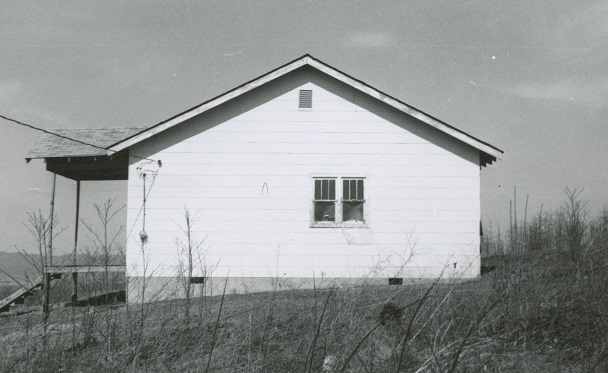
Construction began in 1951 on a small four room building. It included masonry walls, concrete floors, and an acoustic tile ceiling. There were four rooms a foyer and two restrooms with a wood stove. Construction was slow, taking about 6 years. It was dedicated in 1957.

Land behind the chapel was steep and heavily wooded making it impossible to photograph from that angle.

After the dedication, the branch expanded. Auxiliaries were organized, since they could take advantage of the constant access to the building. In a few years it became obvious that it would soon not be big enough. It would only be used for 20+ years before being replaced by the current building.

For a more complete history of the Slate Springs Branch and what became of it, see here...

http://amateurmormonhistorian.blogspot.com/2011/07/church-history-in-crossville-tenn-1878.html

Monday, July 3, 2017

Speedwell Chapel

Speedwell Tennessee entered Mormon history in 1908 with the baptism of Josiah & Harriet Haynes. Several of their children joined too, including a daughter, Pearly Shipley. She opened her home to missionaries when they came through, though at first it was only about once a year. The missionaries split their time between the Shipley family and the Haynes family. But it was widely understood that it was Pearly who was primary support for the Church in the area. Will and Cora Smith joined a short time later.

In 1936 the Speedwell saints were organized into a Sunday School, meeting in the Piney Grove Church on Jones Ridge. It was shared by different denominations and the Mormons used it early Sunday evening. Using a shared meetinghouse was not without its problems. At least once members arrived to find the building locked up specifically to prevent them from using it and guards to explain why.

In 1954 (one source says 1957) Mark Haynes donated land on which the church could build a meeting house. The Shipley and Smith families took out lines of credit to purchase building supplies, which was paid back through various member supported fund raising projects, included selling "sugar beets and green peppers" and other vegetables grown by volunteers.


It was a small wooden one room building located on the crest of Haynes Ridge. You could only get to it by following miles of dirt roads, which became impassable mud roads when it rained.

Carl Shipley, son of Pearl Shipley led the small group. He lived in valley to the north of Haynes ridge (the town of Speedwell is actually in the valley). Each Sunday morning, Brother Shipley drove up the mountain to Haynes Ridge. "Members along the way would see Brother Shipley and his mother, Pearly. They would follow them to the Church for Sunday School."


At first the Sunday School was dependent on the Knoxville Branch, and when that branch was split, they became dependent on the Knoxville South Branch. In 1970, the Sunday School was merged with the LaFollette Sunday School and some members from Tazwell and Middleboro. Of course this meant that Haynes ridge was no longer the best location in which to meet. So meetings there were discontinued in favor of joint meeting location at a house in Fincastle.

The Haynes Ridge building sat unused for a few years before being sold.  Eugene Muggridge describe the circumstances of the sale this way...

"During the Spring of 1974, Silas Mosingo had indicated to Grover Smith that he wanted to purchase the Speedwell Chapel and convert it into a home. He was moving from Michigan to Speedwell as soon as he could obtain a home. A price for the building and the one-acre lot was given by Brother Jim Judge, Church Real Estate Office. The Power of Attorney was delegated to me by the Church to finalize the transaction. Brother Judge sent me a warranty deed which had been prepared and signed by the Presiding Bishop, Victor L. Brown. The strange thing was that Mr. Mosingo insisted on meeting at Cove Lake State Park to make the final exchange of money for the deed. He absolutely refused to meet at the bank in LaFollette. He and I agreed to meet on July 4, 1974 at high noon at a designated place in the park. Not knowing the man, I was very apprehensive about the meeting place and about receiving a large sum of money."

"I lay awake worrying about the unusual arrangement. In preparation for the meeting and in an attempt to remove the fear that was beginning to gnaw inside me, I made arrangements for Roy Gene Smith, Grover Smith, and Leek Mayes to stay close to me during the exchange. These men were Elders, each weighed 250 pounds or greater and carried no fat. The Lord had blessed each with much physical strength, They could be tough if they had to be. Leek Mayes had just moved to Cumberland Gap from Cody, Wyoming where he had been running a ranch and wrestling cows for thirty years. Grover was 6 feet, 4 inches tall and could run like a deer. Roy Gene worked at repairing coal mine equipment and didn't know his own strength. I felt good hiding behind these good men."

"We met at a previously chosen place. Mr. Mosingo came alone and counted out the cash money on the tail-gate of Grover Smith's truck, while we four looked on. While the money lay there in full view, I gave him the warranty deed for the Speedwell building and Grover Smith occupied Mr. Mosingo in small talk, I picked up the money and stuffed it into a bag, then we transferred the bag to the bank. I was a little nervous to say the least, until that money was safe in the bank."

It may sound strange, and I'm not adding this to make a point, but the building burned to the ground "a few years later." Of course that means no current photos are possible.


Monday, June 26, 2017

Short Creek Chapel

Short Creek is a unassuming place along the east side of the Tennessee river in south west Perry County, Tennessee.


This undated photo looks like it was taken in the late 1930's or early 1940's.  That matches the other evidence I have for a branch at Short Creek. The chapel was built in 1928 and dedicated by Charles Callis. Attendance was small, often only consisting of only the Richardson family. In 1930 Jensen noted in his encyclopedia that there was a Sunday School at Short Creek, Tennessee. It wasn't a branch then and he specifically did not include it in his list of the three branches in the state that year. But Alvin Richardson serve as the President from 1928 until 1942. Exactly when it was considered a branch is vague. By 1940 references were using the word "branch" instead of Sunday School. In 1942 Marvin Dedrick was set apart as the new Branch President, a position in which he served until 1972.

I also have this dated photograph from 1944.


I looked at the names associated with the Short Creek branch I find a few who appear to be related to members from the earlier Spring Creek and Cedar Creek branches. This makes sense because those two historic branches were respectively south and north of Short Creek. But Short Creek included members from West of the Tennessee River and over much of Perry County. Another Sunday School met at Pope, Tennessee in Northwest Perry county.

In 1960, the branch moved into the old Lego Schoolhouse. It was only 1.5 miles away, so convenient for those who like the location of the old building. Unlike the previous building, this one had running water and indoor plumbing. Sadly, I don't have a photo good enough to share.

In the mid 1970's the branch had outgrown the Lego Schoolhouse and a new building was planned. A more central location was selected, in Linden, Tennessee. Members west of the Tennessee River were organized into their own unit putting Short Creek out of its central location. The efforts to fund the new building and justify the efforts led to the branch becoming a ward in the late 1970's. At the same time a new name was in order, so the Short Creek Branch became the Linden Ward. This new building is still in use today.


Monday, June 12, 2017

News from Tennessee Conferences 12 Jun 1917


Nashville Chapel circa 1959

In 1959 the Nashville branch of the LDS Church met in this building. For those who know Nashville it is on the west end of town, halfway between Montgomery Bell Academy and Highway 440. It is a very nice part of town.


I've not been able to determine when the LDS Church bought the home or when they vacated it. Online records just don't go back far enough. It is a private residence now. The home sold for $700,000 in 2012. You can see some great photos of the inside here. The new owners built an addition on the back. In May 2015 the home received an honorable mention for residential historical preservation from the Metropolitan Historical Commission of Nashville.